Feeds:
Comments

Posts Tagged ‘African art’

Alma Mater

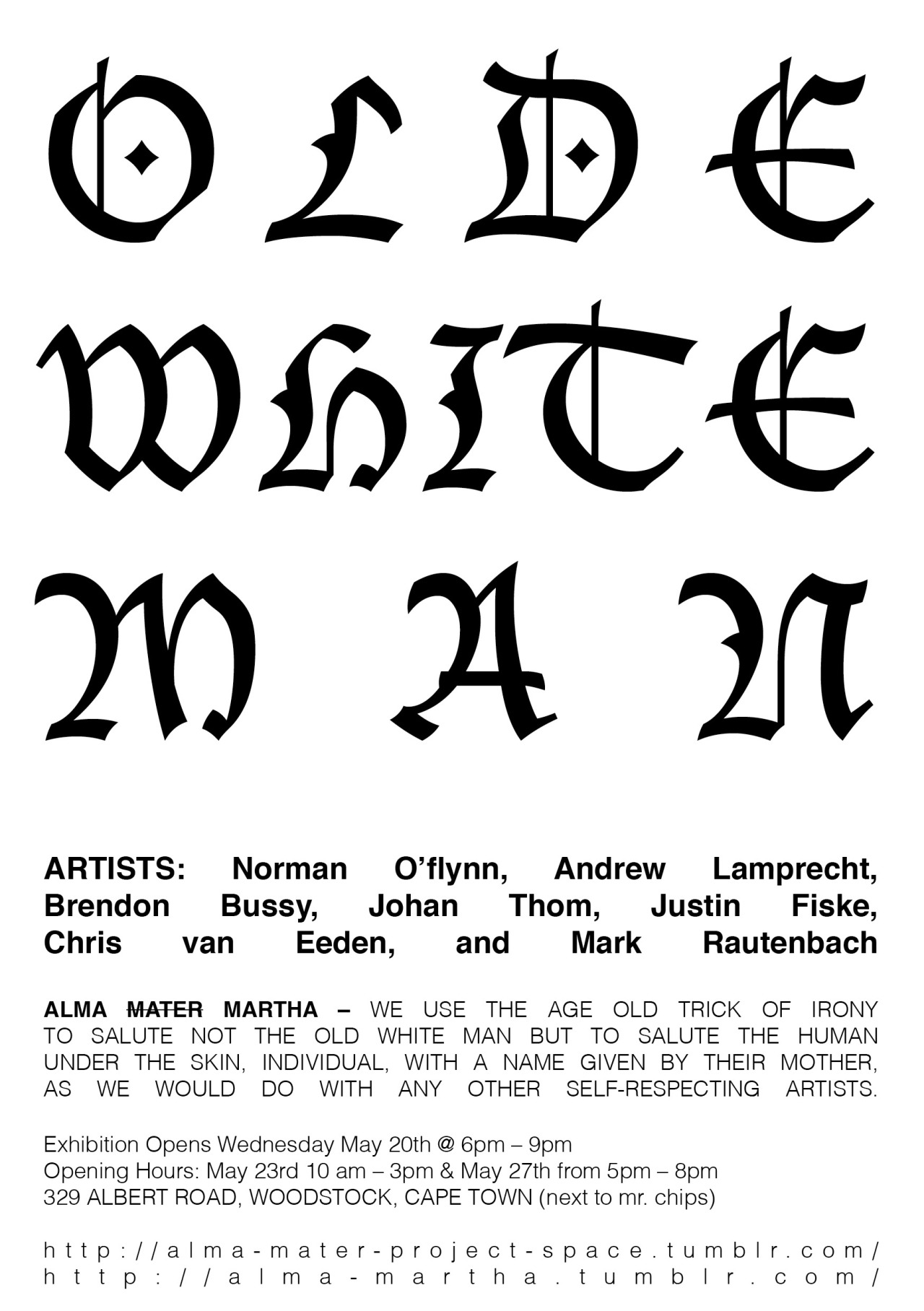
OLD WHITE MAN

Artists: Norman O’Flynn, Chris van Eeden, Andrew Lamprecht, Brendon Bussy, Johan Thom, Justin Fiske and Mark Rautenbach

ALMA MATER

329 Albert Road, 7925 Woodstock, Western Cape, South Africa
Preview: 20 May at 18:00 to 27 May at 21:00


“His comments have a tendency to create social divides. He is a bitter old, white man who does not want to accept that South Africa is in a transitional phase. He must either accept that or hit the ceiling. We [the country] can’t be harnessing people like him anymore,” said Zuma.

This statement was reported in the News 24 article Max du Preez a ‘bitter, old, white man’ on April 24, 2015.

The past always sucks, ask anyone. Why in all this fury of social ‘want to be’ revolution is the youth not directly striking their anger at the current political environment instead of looking backwards? In this momentary haze of fist high, foot down, angst and struggling with the other and self, we decided to host OLD WHITE MAN – a rebellious celebration (of sorts) of the old white man, the man artist forging forward in contemporary mediums, both visual, literary and audible.

Artists are not the enemy – America is, obviously. As an overall generalization, artists in all forms of mediums are, your liberal supporters and pacifists. Most artists whom we know and have invited do not want to be reduced to an OLD WHITE MAN. So in here, which we use the age old trick of irony to salute not the old white man but to salute the human, under the skin, individual with a name given by their mother, as we would do with any other self-respecting artists.

The artists, Norman O’flynn, Chris van Eeden, Andrew Lamprecht, Brendon Bussy, Johan Thom, Justin Fiske and Mark Rautenbach were asked to play at ALMA MARTHA and do what they wanted, without responsibility (respectfully), without judgment. They are old enough for the average pubescent brought up by a Smartphone to wrinkle their nose at (which is, in fact, not very old) and they are old enough to be men who would sit with you to discuss views on the male, masculinity and its context, both personally and on a larger scale. Perhaps they would less likely speak to their white-ness, but maybe it would be best if you ask them yourself.

(OLD WHITE MAN, the exhibition, was planned before the article in News 24 came out. (“Forget the past and come naked without your skin to fight what really matters, not each other but every government.”))

FOOTNOTE: The organizers of OLD WHITE MAN are two women artists, one old (well in so far as the category of which we decided the ‘man’ artists are old,) and one young woman. One is a foreigner and one is local. Both are technically white although the one has sometimes wondered why her Middle Eastern side is considered white on the check off the box category. The other white is local but actually born in an Eastern European country, which also has been known to more centrally located Europeans as the land of the Gypsies and Vampires. One grew up here and the other has been flirting with the country since 2006 and now resides here. Both understand the importance of History and the pain and suffering we acknowledge it and respect it, (one of their logos is a Native American), but would just like to live in the present and be present in the current as well as the contemporary for that matter.

Read Full Post »

AP_150305_110

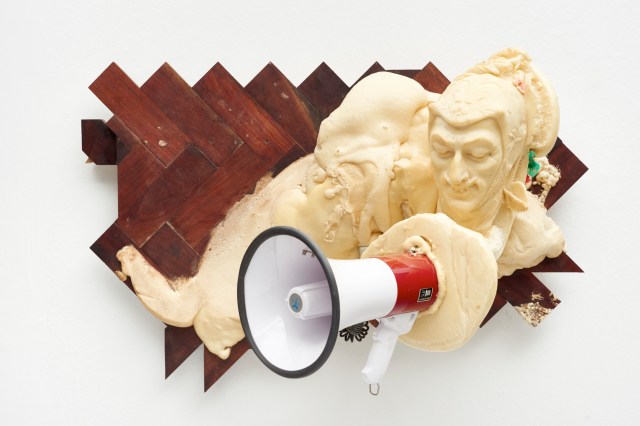
Johan Thom, Faust the African; The Enfant Terrible, 2015 Found objects, builders foam, mixed media 110 x 600 m

Notes for ‘Faustus the African’, a series of artworks by Johan Thom 2014-2015

‘Approach the brink serenely and accept the risk /of melting into nothingness’

(Goethe’s Faust, 57)

‘I look upon myself as a reasonable temple of God’

(Faustus of Milevis, Numidia, North Africa circa 350-400 AD)

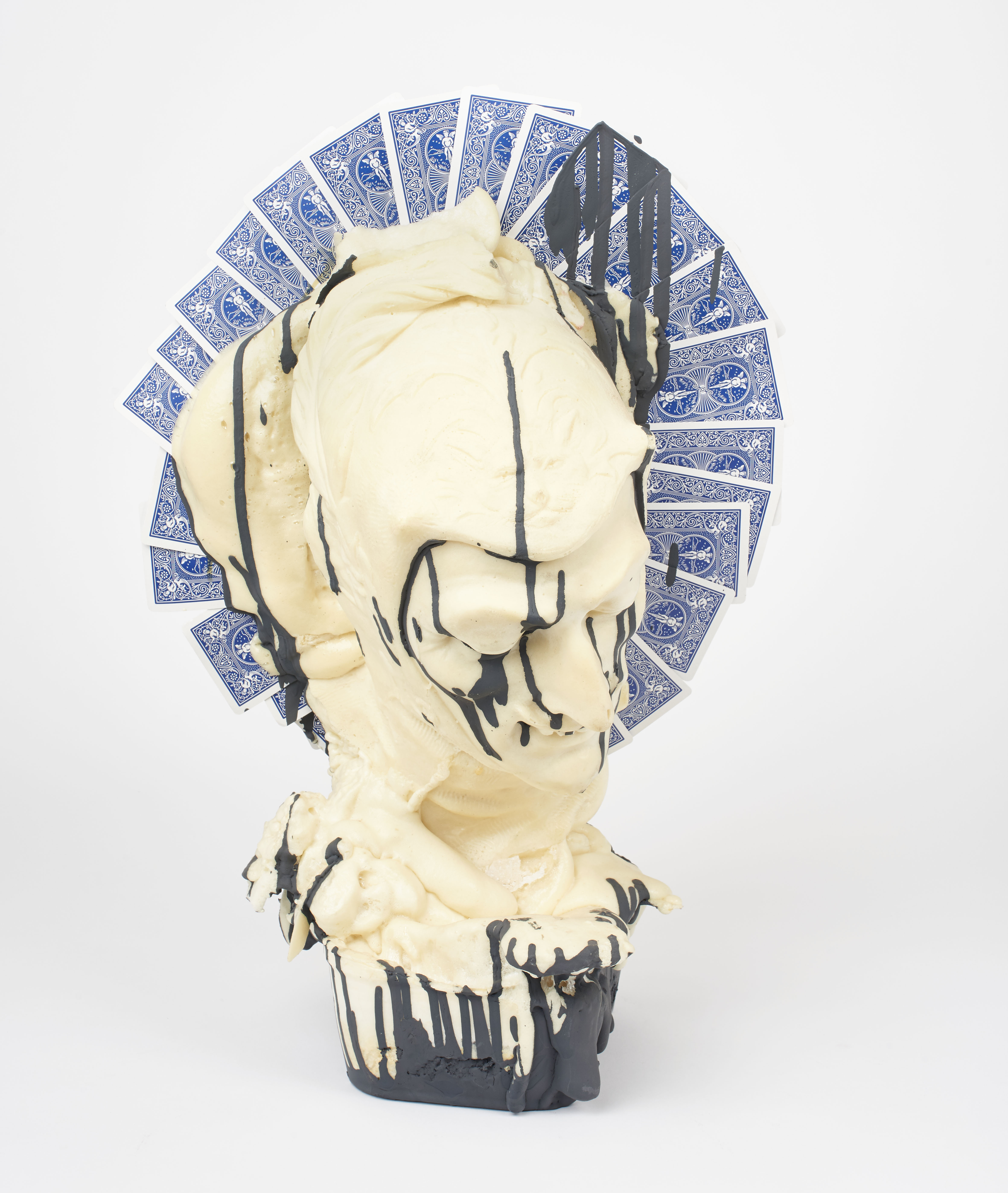
Almost all the works from this series are casts drawn from a 19th century French ceramic bust of Faustus.

I fall in love with this bust of Faustus almost a decade ago. This Faustus is a wall-mounted ceramic in the kitchen my friend Guy Du Toit. Guy tells me that the sculpture has been in his family for as long as he can remember. His mother was frightened by it as child and so too it is with him and with his children. The bogeyman in the hall. But for reasons wholly unclear to me I am drawn to it. This attraction is the starting point for this series of works now known as ‘Faust the African’.

Two interrelated questions. First, why am I drawn to this devilish figure? And, then what does this attraction say about A. the artwork (this particular bust of Faustus, its formal and material properties) and B. about me?

Of course it is one thing to answer these question by speaking or writing about them and completely another to make series of artworks through which to consider and indeed process the answers to these questions. With this caveat in place I turn to a discussion of the working process.

Johan Thom Faust the African; The Explorer, 2015 Found objects, builders foam and mixed media 50 x 40 m

Johan Thom, Faust the African; The Explorer, 2015, Found objects, builders foam and mixed media, 50 x 40 mm

1. Process

Throughout the working process is more or less the same. First I make a silicone mould of the original ceramic Faustus after which I proceed to cast copies thereof in ordinary builders foam.

Builders foam sets in approximately thirty seconds and expands approximately fifteen times its original size. This makes for a rather unpredictable casting process, one in which artistic decisions have to be made in a split second. It is like drawing, or to be more precise like making a quick sketch of a moving figure. If you don’t get it exactly right in the moment, catch the gesture, the form or the movement, no amount of work after the fact can ever fix it.

I enjoy this game and refuse to tame the material. Each time I cast another copy I add however much of the mixture I feel is appropriate. When I add too much the foam bulges and bubbles out of the formal constraint imposed by the mould. The same gaping hole into which the mixture is poured is also the very same cavity from whence the rapidly expanding foam leaks back into the outside.

2. Frozen moments

The whole process of casting with builders foam is a game in which the process itself is captured as something like frozen three-dimensional moment. Again the builders foam sets in a matter seconds – even as it continues to gurgle and expand it coagulates and stalls seemingly mid-movement.
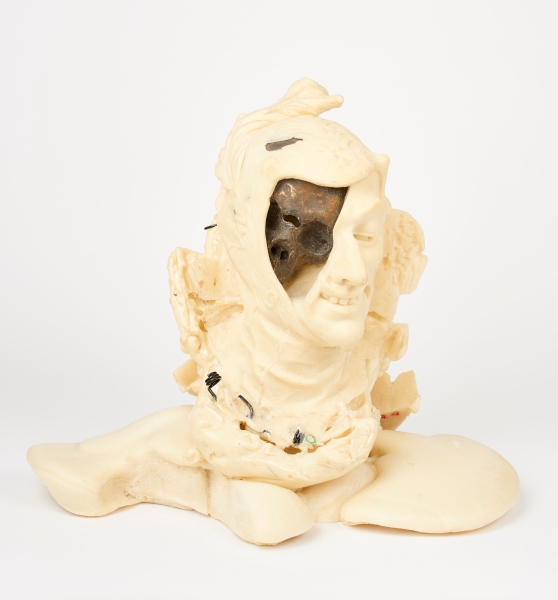
Process image of 'A lone dry skull' by Johan Thom, 2015,  (builders foam, found objects)

Process image of ‘A lone dry skull’ by Johan Thom, 2015, (builders foam, found objects)

I turn the mould around as I pour the thick gooey mix into it. When I de-mould Faustus’ neck and shoulders appear stretched far beyond the limits of ordinary flesh and bone. This Faustus’ plasticky foamy porcelain-like body is presented as if in process of being pulled apart, of oozing, of putrefying and/or of reconstitution itself anew. Over and over again.

A note in my studio reads: “Is this hell? No, there is no hope after hell. This body is being reanimated, given a new lease on life. Besides, I am not the devil”.

3. On character.

Each foam Faustus is unique. Some of the cast heads are smaller, others much larger, clumsy even. But perhaps more to the point, once mounted the different size and shape of each cast lends a particular character to the face of Faustus.

This one seems devious, another withdrawn, one more feminine and others meaner, delirious even evil. But as it is in life so it is in art. Each millimeter matters. Nudge a bust forward by only a fraction and loses its balance, it begins to fall. Suddenly the eyes appear drawn into the skull, the shoulders hunched and somewhat unsure. From a self-assured chin raised high to figure huddled in conspiracy in five millimeters. Add a dash of pink and blue and play havoc with Faustus’ gender.

Each millimeter another gesture, each gesture another world.

4. Combines

Whilst playing with a deck of cards I realize that if I combine these foamy Faustusses with other objects the difference between the casts can be explored with even more depth and complexity. In this case, I create a Janus-type head that resembles a figure from Victorian English Royalty: the Victorian ruff collar made from a spread of cards, one side Dutch blue and white, on the other, red and black figures (numbers, kings and queens and so forth). I laugh when I mount this obscene two-faced-figure on an ice cream bucket. Presto! The ruff collar is transformed into a sail for a tub. But where to? (The colonies is suspect).

APP_141212_009

Johan Thom Faust the African; The Gambler – Royalty, 2015 Found objects, builders foam and mixed media 45 X 156 m

For “Faust the African: Health and Sanitation” the bust is coupled with a wooden toilet, an antique potty trainer. This a tongue in cheek ode to Duchamp’s ‘Fountain’ of 1917 but also to the ‘History of shit’ (1978) by Dominique Laporte, a little known but rather amazing book about the sewers of Paris. To be more specific, Laporte chronicles the history of sewage in Paris and how, after completely re-building the city in the nineteenth century as the modern French capital, residents are finally forced to take ownership of their waste.

This game with found objects and meaning seem to me closely analogous to way in which I relate to the objects that populate my material surroundings and how in turn, these surroundings exercise a very real influence on my identity as an individual. Put two or more seemingly disparate elements together – a paintbrush, a speaker and a head cast in foam – and soon other things start to happen. ‘Other’ as something in between them that is really irreducible to any single element or predetermined causal structure.

This is some kind of magic, one found in the particular way surfaces rub off on one another. To use a metaphor, we are attracted to our mates because we desperately desire to be close to them. If this is so it is because there is always a fools hope that the magic that so imperceptibly draws us to them may rub off on us. But only if we can get close enough, for long enough.

And what of objects? Are we immune to their charms? I think not.
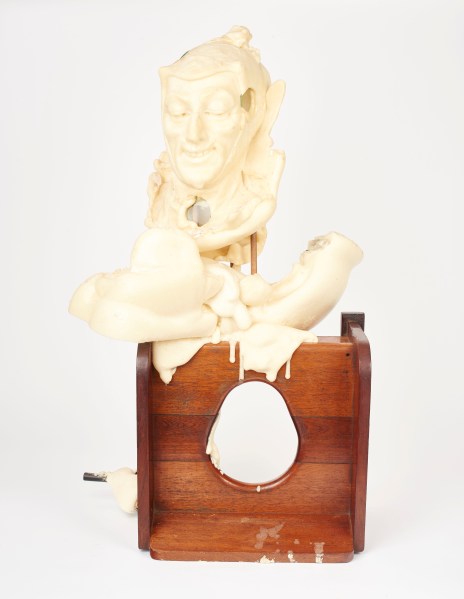
APP_141212_035

Johan Thom Faust the African; Health and Sanitation, 2015 Found objects, builders foam and mixed media 160 x 61 x 40 m

5. Performative relations

My meaningful relationship with the objects included in this body of work is time and place specific. That is to say this relationship is indelibly shaped by the experiences, ideas, discrete histories and even the presence of the other objects that I may encounter in a particular moment.

During a breakfast at a small restaurant in Queenswood, Pretoria I discover standing beside my chair a wooden potty trainer for sale at the antiques shop next door.

Whilst browsing through a second hand bookshop, I read about erstwhile leader of the South African Communist Party Chris Hani’s disgust with the armed struggles’ military training camps during apartheid. In brief, Hani was infuriated by the fact that the exiled comrades and military trainers were living a life of luxury whilst the new recruits were dressed in rags, semi-starving boys with guns.

And Faustus? Well let me just say as a product of Afrikaner Calvinism I applaud the man that shunned superstition and chose reason, no matter what the final outcome.

In this way the foam casts of Faustus exist as the very material embodiment of my performative relationship with the original object and its varied meanings. Faustus has a meaningful history and I cannot neatly extrapolate my attraction to the object from those meanings.

But still, the object also exists in the here and now, and so it would be utterly foolish to pretend that all I love is its history, the story of Faust if you will.

To only love history, received narrative is to be trapped in a loveless relationship that will never be consummated in the here and now. And how could it?

To love a ghost is to love nothing but your own nostalgia.

AP_150305_023


Read Full Post »

Johan Thom talks about “The devil made me do it” solo at the Goodman Gallery, 7 March 2015.

Thom is a multidisciplinary artist, frontrunner of a Now Generation of South African practitioners drawing on dramatic histories while creating self-reflexive journeys. His work encompasses two disparate elements: dark humour and light tragedy. It deals with the dividing line between the self and the other where the former fulfils the role of a crazy loner seeking agency, while the latter is a real life arbitrator of reason and knowing.

The exhibition will consist of a series titled Faust the African made up dozens of heads cast from a 19th Century bust of Faust, in builder’s foam, and inlaid with found objects making a macabre and carnivalesque gallery of types. These include an explorer, a gambler, a musician as well as the well-worn men one would find on a travelling vessel, taking an epic journey of exploration. Video, discarded books, drawings on blackboard ink and cast bronze artifacts complete the hellish depiction of a semi-fictitious person seeking out dangerous

Johan Thom gesels oor sy nuwe uitstalling “The Devil Made Me Do It”. Wees deel van kykNET se Youtube kanaal vir soveel meer kykgenot. Volg kykNET op Twitter:…


Read Full Post »

Johan Thom / The Devil Made Me Do It / 2015

07 March – 11 April 2015

28924exhibition554-1020_front

Read Full Post »

ANALOGUE EYE is a mobile drive-in theatre and pop-up cinema experience. The project pays homage to the traditional drive-in experience and to early projectionists such as Sol Plaatjie, who traveling across South Africa, took the moving image to the people. In this vein and spirit Analogue Eye has taken the video works from the gallery context to meet a wider audience in unexpected public platforms and spaces. Video Art Africa is a curated screening of three programs of diverse video artworks made by 37 artists about, from or on the African continent.
Featuring 37 Artists from 18 countries.

Created & curated by Brent Meistre

More info here: https://www.facebook.com/ANALOGUEYE?fref=photo

Read Full Post »

Installation view of collaborative sculpture at Nirox Sculpture Park.

With Guy du Toit.


Read Full Post »

Image

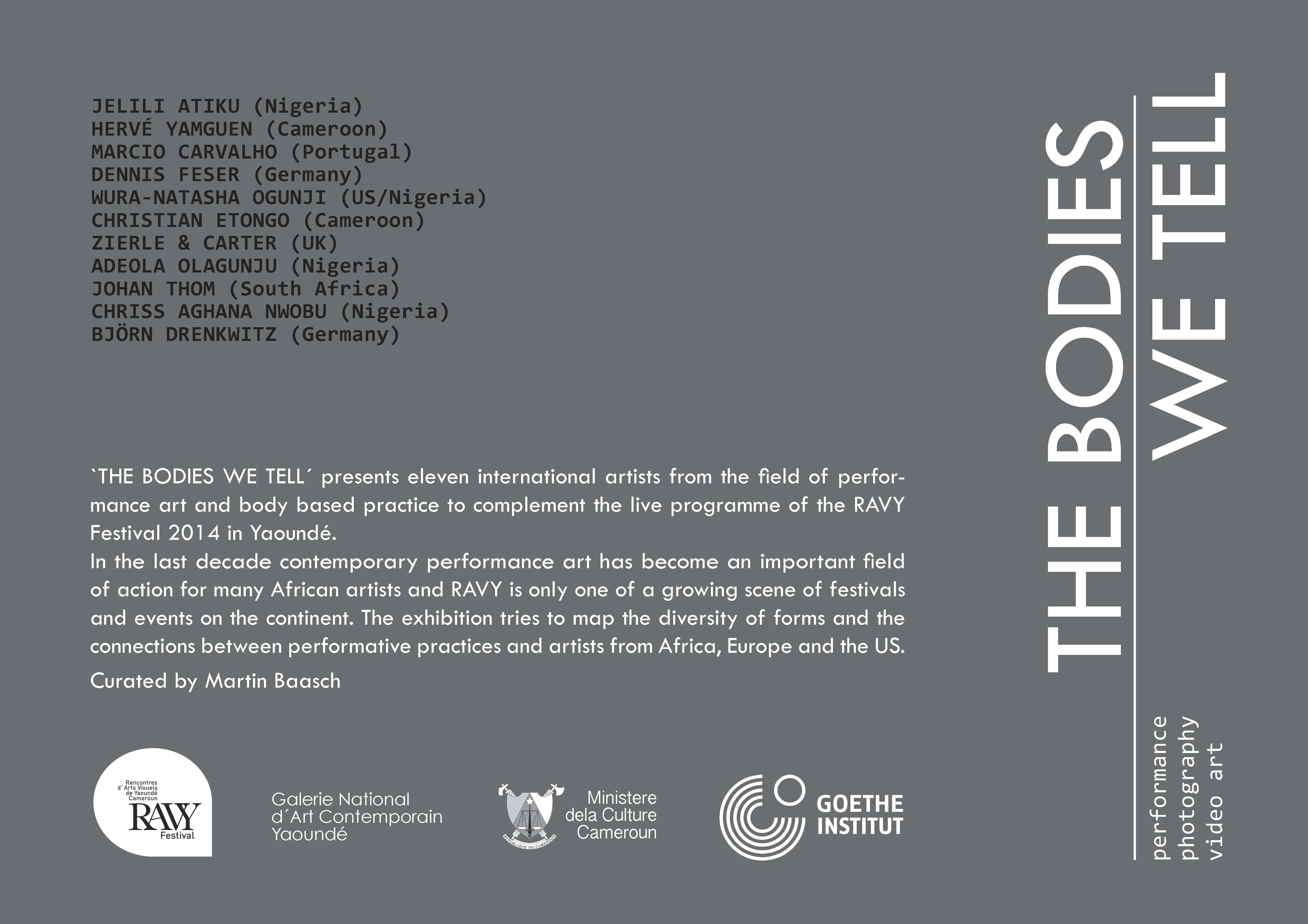
Bodies_We_Tell_Postcard_2_Final_Page_2


Read Full Post »

This slideshow requires JavaScript.

Read Full Post »

videoabend: Still Fighting Ignorance & Intellectual Perfidy

Film
Mittwoch, 03.04.2013, 20:00 – 22:00 Uhr
Motorenhalle – Wachsbleichstraße 4a, 01067 Dresden

Der Kurator Kisito Assangni ist anwesend und gibt im Gespräch mit Frank Eckhardt eine Einführung. Zwischen den Blöcken und zum Ende steht er zur Diskussion bereit.

http://sfip-project.blogspot.com

Der Videoabend präsentiert eine länderübergreifende Auswahl heutiger afrikanischer Videokunst. “Still Fighting Ignorance & Intellectual Perfidy” kontextualisiert afrikanische Videokunst in einem größeren kulturellen Rahmen. Im Zeitalter interkultureller Migration präsentiert [SFIP] auch Afrikanische Videokünstler/innen, die in Afrika, Europa und den USA zu leben. Ein verbindendes Element bildet das Interesse an den Beziehungen zwischen dem Selbst und der Gesellschaft. Die meisten Werke thematisieren Fragen von Alternativen, Identität, Toleranz und sozialen Beziehungen. Die experimentellen Videos konzentrieren sich auf ästhetische und methodische Perspektiven des Kampfes gegen Unwissenheit und geistige Niedertracht in der zeitgenössischen afrikanischen Kunst. Das Projekt erzählt Geschichten Afrikas von Afrikanischen Medienkünstler/innen wie durch die Linse der Beziehung zwischen Tradition und Zeitgenossenschaft.

Liste der Werke:
> * Said Afifi, Metamorphosis of the linguist #2, 4’58”, 2010 (Morocco)
> * Jude Anogwih, STOP! 2’04”, 2010 (Nigeria)
> * Younes Baba-Ali, Call for Prayer – Morse, 3’06”, 2011 (Morocco)
> * Wanja Kimani, Buttons, 2’03”, 2010 (Kenya)
> * Nicene Kossentini, Myopia, 3’13”, 2008 (Tunisia)
> * Kai Lossgott, Read these roads, 3’58”, 2010 (South Africa)
> * Victor Mutelekesha, Shadow of my shadow, 3’39”, 2009 (Zambia)
> * Saidou Dicko, Le petit Berger, 5’14”, 2011 (Burkina Faso)
> * Ndoye Douts, Train train Medina, 7’02”, 2001 (Senegal)
> * Samba Fall, Oil man, 1’00, 2008 (Senegal)
> * Nathalie M’ba Bikoro feat. Iris Musolf, Hide & Seek, 5’33”, 2010 (Gabon)
> * Saliou Traoré, Traffic mum, 10’00”, 2009 (Burkina Faso)
> * Ezra Wube, Gela 2, 1’57”, 2010, (Ethiopia)
> * Nirveda Alleck, Perfect match, 6’32”, 2009, (Mauritius)
> * Rehema Chachage, Kwa Baba Rithi Undugu, 1’23, 2010 (Tanzania)
> * Kokou Ekouagou, Taller man, 2’20”, 2011 (Togo)
> * Mohamed El Baz, FUCK THE DEATH, 11’10”, 2011 (Morocco)
> * Dimitri Fagbohoun, Black brain, 4’02”, 2010, Benin
> * Michele Magema, Interiority-Fresco IV, 2’31”, 2010 (D. Congo)
> * Johan Thom, llumination, 2’03”, 2012 (South Africa)
> * Guy Woueté, Le dilemme divin, 5’31”, 2009 (Cameroon)

Kurator:

Kisito Assangni

Read Full Post »

Malmo Konsthall presents
*STILL FIGHTING IGNORANCE & INTELLECTUAL PERFIDY*
Video art from Africa
Curated by Kisito Assangni

2 March – 7 April 2013

MALMO KONSTHALL
C-Salen
S:t Johannesgatan 7
250 80 Malmo
Sweden
www.konsthall.malmo.se
http://sfip-project.blogspot.com

Including
Said Afifi | Nirveda Alleck | Jude Anogwih | Younes Baba-Ali | Rehema
Chachage | Saidou Dicko | Ndoye Douts | Kokou Ekouagou | Mohamed El Baz |
Samba Fall | Dimitri Fagbohoun | Wanja Kimani | Nicene Kossentini | Kai
Lossgott | Michele Magema | Nathalie Mba Bikoro | Victor Mutelekesha |
Johan Thom | Saliou Traoré | Guy Woueté | Ezra Wube

Project [SFIP] is a multi-national exhibition process and a platform for
critical thinking, researching and presenting African video art.

Read Full Post »

« Newer Posts