Feeds:
Comments

Archive for the ‘News’ Category

Doing Research: An Exercise in Thinking about the Meaning of Artistic Research in the Academy Context

EARN Members will collaborate with dOCUMENTA(13) becoming an activating agent in the main exhibition programme and collaborating on a series of workshops and a symposium

http://www.artresearch.eu

dOCUMENTA(13)

The EARN Academies network is participating in dOCUMENTA(13). There are four strands to this collaboration: (i) activated projects; (ii) “Doing Research” a chapter of the conference “On Artistic Research” co-organised with dOCUMENTA(13) (September 8 and 9); (iii) a book on different definitions, approaches, critical responses and positions on the question of artistic research to be released in advance of the conference; and (iv) a programme of workshops by doctoral researchers (September 6 and 7).

A. Activated Projects

This participation is framed in a number of different ways and raises complex issues about the mobilisation of students and researchers within a large scale machine for visibility such as documenta. The presence of student artists and researchers as activating agents within artworks authored by other artists and articulated within the elaborate curatorial matrices of dOCUMENTA(13) creates many challenges and debates: These range from the prerogatives of academies vis-a-vis other institutions (exhibitions, biennials, showcase platforms, curatorial discourse) to the operational economies of production and the outsourcing of labour inputs. There is clearly a wide diversity of models of “activated” project – entailing different orders of student / researcher participation, input and agency. Exampels include: (i) Theaster Gates restoring and reactivating the historic Huguenot House in Kassel with student input; (ii) Paul Ryan’s Threeing comprised of situations in which three or more people create sustainable, collaborative relationships; and (iii) Robin Kahn and the Women of Western Sahara’s “jaima” (tent) project.

B. “Doing Research”

Doing Research aims to understand the various ways in which research is understood and practiced by artists – in this case artists involved the d(13) activated projects, as well as artists involved in European doctoral programs. Structuring this enquiry are a series of six questions:

B.1 Questions: Understandings of artistic research

(i) What is your definition of doing (artistic) research? Does artistic research need an institutional framework or could it be legitimized differently? Does the institutionalization of research imply an instrumental control and a reduced conception of art? Or is does it also create room for matters such as unexpected and independent artistic forms, and openness to conflict and difference?

(ii) Do current research-connotations and protocols limit the domain of artistic imagination? Or could research-based art lead to novel forms of
(critical) consciousness? What could be the implications of the research discourse for aesthetic qualities such as the non-discursive, the not-knowing, and the intuitive, and what does this mean for your practice?
Artist and researcher

(iii) Do you see your own work as research-based? How does research affect your practise and your position as an artist? Or do you consider the topic of research obsolete in the realm of art? What, then, is a current topic or emergent theme in visual art that might be an alternative to the focus on research?

(iv) What does thinking in terms of research mean for your self-understanding as an artist? Can you, as an “artist”, identify with the role and identity of a “researcher”? Or do you expect that the practice of artistic research will contribute to re-thinking and re-assessing the established concept of researcher?

B.2 Related concepts and terminologies

(v) Do you consider your practice with reference to ideas of political economy? How could an artistic (research) practice relate to current conditions of “capital” and to what are seen as the ubiquitous forms of “cognitive capitalism”? Do you see possibilities for the production of alternative social and economic strategies in your work? How could artists currently demand attention for emancipatory forms of knowledge and experience that enable the world to be thought differently?

(vi) To what extent do you think and work in terms of “knowledge production”? Is the current “biopolitical” expansion of the notion of production a theme in your work? Are these terms familiar and/or of relevance for you in thinking about your practice?

C. The Book

The book “Doing Research” (published by the Finnish Academy of Fine Arts) which features contributions from dOCUMENTA(13) artists and EARN researchers will be avialable from mid-August 2012.

D. EARN@dOCUMENTA(13) Doctoral Workshops

The format of the workshops is relatively open – Each session is with one or more artist/researchers from an EARN academy presenting on some aspect of their current research. For some researchers the workshop may be based on interpreting / responding / re-setting the agenda generated by the questions and responses from “Doing Research” (see above). But many workshops simply emerge from the priorities of the work and concerns of the students presenting. Presenters include:

1. Laura Kuch (SLADE UCL)
2. Kai Syng Tan (SLADE UCL)
3. Beatrice Jarvis (GRADCAM ULSTER)
4. Giulia Cilla(ACADEMY OF FINE ART VIENNA)
5. Ingrid Cogne(ACADEMY OF FINE ART VIENNA)
6. Elske Rosenfeld (ACADEMY OF FINE ART VIENNA)
7. Fiona Curran (SLADE UCL)
8. Martino Genchi (IUAV Bevilacqua Ateliers)
9. Giovanni Giaretta (IUAV Bevilacqua Ateliers)
10. Annette Krauss (MAHKU)
11. Jem Noble (GRADCAM DIT ASSOCIATE RESEARCHER)
12. Henna Halonen (FINNISH ACADEMY OF FINE ART)
13. Kay Tabernacle (SLADE UCL)
14. Tim Long (SLADE UCL)
15. Michael Delacruz (SLADE UCL)
16. Eleanor Morgan (SLADE UCL)
17. Johan Thom (SLADE UCL)
18. Lisa Tan (VALAND ACADEMY GU)
19. Georgina Jackson (GRADCAM DIT)
20. Rana Ozturk (GRADCAM NCAD)
21. Aislinn White (GRADCAM ULSTER)
22. Eirini Boukla (LEEDS)
23. Claire Hope (LEEDS)
24. Elke Marhöfer (VALAND ACADEMY GU)
25. Errol Francis (SLADE UCL)
26. Ming-Han Hsu (Taipei National University of Arts)

Read Full Post »

Curated by Jayne Crawshay-Hall

You are invited to the opening of

ME 1

on Saturday the 4th of August at 18h30


Curated by Jayne Crawshay-Hall

A major interest within contemporary art is the increasing search for identity along with an increasing sense of selfreflexivity.  Gleason (1983:910) states that “identity came into use as a popular social science term only in the 1950s at which time it was assigned not to particular racial, cultural, or sexual differences but to the self as an existential category.” Me 1 is an exploratory exhibition featuring works in a variety of media that investigate the way we create the understanding of identity through art.  The exhibition includes works by Johan Thom, Senzeni Marasela, Lionel Smit, Rozan Cochrane, Bongi Bengu, Oliver Mayhew  and Jayne Crawshay-Hall, who all seem to be involved in the examination processes of forming, inheriting and expressing personal and social identities.  The exhibition encourages the audience to re-examine basic assumptions about identity within our “anonymous society” (Gleason 1983:69), and prompts the viewer to question preconceived ideas of identity, in order to reach a stable sense of selfhood. 


Sources consulted:

Gleason, P. 1983. Identifying Identity: A Semantic History. Journal of American History (69).


Read Full Post »

21 YEARS AT THE BAG FACTORY ARTISTS’ STUDIOS

We would like to invite you to join us for 21BF, a 21st Retrospective Exhibition. The exhibition, curated by Melissa Goba and assistant curator Tammy Langry aims to reflect on the diversity and creativity of artists who once held or still hold studio space at the Bag Factory.

Participating artists include:

Wayne Barker || Hedwig Barry || Bongi Bengu || Belinda Blignaught || Nicky Blumenfeld || Ricky Burnett || Reshma Chhiba || Iris Dawn Parker || Bongi Dhlomo || Paul Emmanuel || Fatima Fernandes || Kate Fountain || Gordon Froud || Rookeya Gardee || Kendell Geers || Nadine Hutton || Diana Hyslop || Verna Jooste || David Koloane || Moleleki Frank Ledimo || Benon Lutaaya || Colbert Mashile || Tamar Mason || Pat Mautloa || Tshepo Mosopa || Sam Nhlengethwa || Thenjiwe Nkosi || Richard Penn || Fidel Regueroes || Joachim Schonfeldt || Lerato Shadi || Penny Siopis || Dinkies Sithole || Pamela Phatsimo Sunstrum || Myer Taub || Johan Thom || Jill Trappler || Dominic Tshabangu || Hentie van de Merwe || Mary Wafer

Opening night: Friday 03 August
Time: 5:30pm to 10:30pm
Location: Bag Factory Artists’ Studios, 10 Mahlatini Street, Fordsburg

The exhibition will run until Monday 10 September 2012. Please keep your eyes on our facebook (BagFactoryArt) page for the full calendar of events during the exhibition’s run.

The Bag Factory would like to thank its funders who have made 21BF possible.

facebook linkedin twitter
©2012 Bag Factory Artists’ Studios | 10 Mahlatini Street, Fordsburg, Johannesburg, 2001

Read Full Post »

Torrance Art Museum presents

STILL FIGHTING IGNORANCE & INTELLECTUAL PERFIDY

Video art from Africa

Curated by Kisito Assangni


July 21 – September 1, 2012


TORRANCE ART MUSEUM

3320 Civic Center

Torrance, California

90503 USA

www.torranceartmuseum.com

http://sfip-project.blogspot.com


Including

Jude Anogwih | Younes Baba-Ali | Saidou Dicko | Ndoye Douts | Kokou Ekouagou | Mohamed El Baz | Samba Fall | Nicene Kossentini | Kai Lossgott | Michele Magema | Nathalie Mba Bikoro | Johan Thom | Saliou Traoré | Guy Woueté | Ezra Wube


Read Full Post »

This slideshow requires JavaScript.

Curatorial Notes on ‘(in)Visible bodies: Migrants in the city of gold’

I have included in Cities Methodologies 2012 three projects produced by artists from Johannesburg. Each of the selected projects encapsulates a particular understanding of the realities of living and working in the contemporary urban cityscape of Johannesburg. However, when grouped together, the relationship between movement and the visibility of the body becomes a central motif that allows for a more multifaceted, complex vision of the city of Johannesburg to emerge.

The concept of ‘migration’, as the movement of bodies from one place to another, is utilized as a useful framework through which to rethink the complex interplay between what is rendered in/visible by the symbolic, economic, political and historic dimensions of the city of Johannesburg.

The three works are ‘Challenging Mud – after Kazuo Shiraga’ (2008) by Johan Thom, the ‘Hillbrow/Dakar project’ (2007-8) by Hobbs/Neustetter and the ‘TrolleyWorks’ (2007) by Ismail Farouk.

1. Movement and complexity

All three works contain trace elements of the ongoing material movement of bodies within, into and from the city of Johannesburg:  Whether it concerns the physical act of carting over-sized baggage from the taxi rank in modified supermarket trolleys as shown in ‘TrolleyWorks’ by Farouk, using hand-drawn city maps to go searching for long-lost friends, family or familiar places located elsewhere in Africa as shown in the ‘Hillbrow/Dakar’ project by Neustetter and Hobbs, or witnessing the slow process of burying a body covered in gold presented by Thom in ‘Challenging Mud’.  In turn, this movement continues to shape the city of Johannesburg and its prominent place within Africa and the world.

Artists, entrepreneurs and people of vastly different interest and backgrounds from all over Africa and the globe continue to flock to Johannesburg in search of the reward and recognition it promises. In this regard it may be argued that the fact of the discovery of gold in 1886 remains ever-present in the Johannesburg’s contemporary status as a highly sophisticated, economic metropolis – one that is often locally referred to as eGoli, the ‘place of gold’, in Zulu. Today this idea is largely symbolic with the depletion of the gold reserves fast becoming a reality. (It is estimated that up to forty percent of the world gold reserves have been unearthed in and around Johannesburg). However, in its stead the world of corporate business, global banking, sports and electronic media continues to make Johannesburg the largest business center in South Africa and arguably all of Sub-Saharan Africa. In this way the city continues to engender a sense of hope and possibility, one it is argued here as being underpinned by the possibility of ‘becoming-visible’ by and through ones belonging to it.

In this regard, in choosing to group such different projects together I want to allow for complexity to emerge beyond the familiar post-apartheid South African narratives of race, exploitation and poverty: For example, the contemporary (im)migrant community at stake in the ‘Hillbrow/ Dakar’ project is Senegalese and not simply the European colonial settlers of centuries ago. Similarly, in Farouk’s ‘TrolleyWorks’, the harsh brutality of making a living within the informal economy of contemporary, urban Johannesburg is highlighted – the difficulty of which remains almost invisible to the more familiar narratives of economic growth/ inequity and racial disharmony that have, for better or for worse, become the lingua franca of South Africa’s ongoing participation in global society. Born in Johannesburg, Thom is a descendant of Scottish immigrants that first came to South Africa in search of better prospects now more than a century ago.

2. The Rainbow Nation

Perhaps in retrospect the miracle of South Africa’s peaceful transition to democracy under the banner of the ‘new South Africa’ in 1994, seems largely premised upon the fulfillment of a multi-racial vision, and not that of the recognition of a multi-cultural strata of ever-changing ‘migratory bodies’ through and by which a city like Johannesburg first came into existence.

Contemporary post-apartheid South Africa is the ‘rainbow nation’, a trope that is in turn largely premised upon reconfiguring the value of skin color within, and part of, a nation-state in the singular. In South Africa the value of race has long served only to divide: The implementation of ‘Apartheid’ (literally ‘separateness’) from 1940 by the National Party effectively split the country into separate territories for various racial groups. Under the Group Areas Act of 1948 these territories, or ‘homelands’ were placed under control of a central white government. Ordinary South African’s were not allowed to reside in each others’ legally designated territory and black South Africans were expected to carry a ‘pass’ with them at all times (the passes were something like passports showing their territory of origin, place of temporary residence and current employ). Failure to produce a pass could result in immediate detention, physical beatings and even deportation.

Such draconian policies were a direct result of the uneven workings of Apartheid, with cities such as Johannesburg effectively forming a part of ‘white’ South Africa. Of course with discovery of gold (amongst other minerals) a large labor force was needed to exploit this abundant natural resource. People from rural South Africa now flocked to Johannesburg. But through the policy of Apartheid black South African’s were rendered as a temporary and cheap resource of labor: they were merely migrant laborers on contract, with little to no recourse to the laws, amenities and general infrastructure such as healthcare provided by white South Africa for its white citizens. The black mine workers were effectively treated like prisoners, isolated in mine compounds and driven to and from their place of work by their employer. In this way highly profitable industries such as the gold mines were owned and managed by white South Africans (often in cahoots with conglomerates from western Europe) with black South Africans forming part of a largely unskilled, temporary labor force that could be drawn from, dispatched and ultimately dismissed at will.

But I daresay that not even the brutal machinery of apartheid could effectively control the mass migration people of all creeds and colors to a city like Johannesburg. Massive ‘townships’ (something like informal settlements) sprung up all over South Africa close to cities and sites of industry.  For example, near Johannesburg the township of Soweto – an acronym for ‘South Western Townships’ – quickly became a city unto itself, with hundreds of thousands of ‘temporary’ black workers finding refuge in its confines. Soweto is located on what is colloquially known as the ‘mining belt’ – a stretch of land (including Ekurhuleni, Boksburg, Germiston, Brakpan and Johannesburg, amongst others) where massive supplies of gold have been, and continue to be, unearthed.

Importantly, townships like Soweto became hotbeds of political activity, where anti-apartheid organizations such as the African National Congress and the Pan African Congress could flourish. Soweto is perhaps best known today for the ‘Soweto Riots’ of 16 June 1976, when the twelve-year-old pupil Hector Peterson was gunned down and killed by the Apartheid police.

3. Visible matter/ Invisible forces
Today the relative invisibility of the trolley pushing community, and indeed that of the huge African immigrant community in Johannesburg, also bolsters the possibility of their systematic economic, political, cultural exploitation within the confines of urban Johannesburg. The wave of xenophobic violence that engulfed South Africa in mid 2008 also affected Johannesburg, where at the height of the outbreak privately owned taxis would refuse to carry immigrants from elsewhere in Africa, for example (something this author experienced firsthand).

Here ‘Challenging Mud’ by Thom hints at the golden promise of better prospects and the somewhat ritualistic, though commonplace violence of its denial to the bulk of Johannesburg’s population. Access to wealth remains the privilege of a select few with various forms of social, cultural and economic inequity all fostering a deeply divided society. However, in configuring this division along purely racial lines of erstwhile apartheid ideology a broad range of narratives, lives and livelihoods are today effectively erased from public view.

Of course, as the projects included here would suggest this erasure is always temporary, contingent as it is upon the ongoing process of making (in)visible of migratory bodies within the ever changing city and the socio-economic and political narratives that seek to define & fix their place within it.  In this regard it is argued that the sheer materiality of the projects in question anchors them in a resistant ‘real’, one that frustrates the grand narratives of identity, place and belonging such as narrowly conceived of within the ‘apartheid’/ ‘post-apartheid’ continuum.

4. Migratory bodies, cities and identities

Though Johannesburg may be defined in large by it’s history, its continued relevance and prominence in the world is certainly also due to the relative ease with which one may engage with, move through and generally make yourself physically visible to others, whether it concerns making a living, striking up a casual conversation or even making art. For here within this curated grouping of artworks, beyond the well-known history of mining and the struggle against apartheid, the city of Johannesburg is conceived of in more intimate, personal and corporeal terms too. Bodies are not merely laborers or static placeholders that embody a single racial identity but are conceived of as being dynamic, ever-moving physical entities that constantly traverse and give palpable form to a city.

In short, despite the lingering importance of displacing the narratives of Apartheid, there exist a real need to think about the more intimate, corporeal gestures and interactions of say, drawing a map from memory whilst talking to strangers, of burying a family member, or even of pushing a shopping trolley through a massive, contemporary city in order to make a daily living.

Lastly, it is fitting to note that, despite their widely diverging content and focus, all three works are indeed collaborative in nature. Each of these works was made possible by intimate, personal exchanges between the artists and the different communities at stake. Even ‘Challenging mud’ by Thom, that may appear to be a rather straightforward video installation artwork, is in fact a deeply collaborative effort: firstly by virtue of the involvement of friends and family during the process of its making and, secondly, through its tact acknowledgement of the viewer via the exact form of its display in the gallery.

Johan Thom, 2012

Read Full Post »

Image

UCL Cities Methodologies 2012

UCL Urban Laboratory exhibition and events programme showcasing innovative urban research methodologies

4-7 July 2012

Launch, 4 July, 18.30, all welcome

Open Thurs to Fri 10.00-20.00, Sat 10.00-13.00

UCL Slade Research Centre, Woburn Square, London, WC1H 0NS

All events are free and open to the public. For full programme of events and exhibitors please click here

Inaugurated in 2009, Cities Methodologies is an initiative to showcase innovative methods of urban research from across UCL and the wider urban research community. Through peer-reviewed exhibits and events, it draws together undergraduate, masters, and doctoral research, alongside work produced by academics and other researchers and practitioners. Cities Methodologies promotes cross- and inter-disciplinary work and this year showcases recent research on a wide range of cities including Detroit, Paris, London, Johannesburg, Mumbai and Beirut.

This year, through a public call for participants, we particularly‚ though not exclusively‚ welcomed proposals on:

• Collaborative/public methods for urban research

• Mega events and urban change

• Housing and dishousing

Visitors to Cities Methodologies will encounter diverse methods of urban research in juxtaposition – from archival studies to digital media experiments, practice-led art, architectural and design work to film-making, soundscapes, games and public sculpture.

Image

2012 contributors include:

Adriana Allen-Rachel Alliston-Sarah Bayliss-Megan Bradshaw-Otto von Busch-Ben Campkin-Caterina Carola-Vanesa Castán Broto-Alejandra Celedon-Paul Charman-Julian Cheyne-Steven Chodoriwsky-Philip Comerford-Steve Dowding-Andreas Eriksson-Ismail Farouk-Gynna Franco-Hayley Gewer-Mohamad Hafeda-Hanna Hilbrandt-Steven Hobbs-Sandra Jasper-Sebastian Juhnke-David Kroll-Angela Last-Matteo Melioli-Rebecca Merrill-Ignacia Mesa-Agnieszka Mlicka-City as Interface: Ava Fatah gen Schieck, Moritz Behrens, Tasos Varoudis, Christos Chondros, Eleni Georgiadou, Lida Theodorou, Stefanos Gkougkoustamos, Yimeng Tang, Martin Traunmueller-MSc Building and Urban Design in Development-MSc Urban Studies-Azzurra Muzzonigro-Marcus Neustetter-Benny Nilsen-Farid Noufaily-Fíacha O’Dubhda-Alexandra Parry-Brent Pilkey-Hilary Powell-Liz Rideal-David Roberts-Mireille Roddier-Rebecca Ross-Troy Schaum-Rachel Scicluna-Ariel Shepherd-Rosalyne Shieh-Henrietta Simson-Martin Slavin-Carolyn Smith-Anna Subirats-Johan Thom-Evren Uzer-Jo Volley-Mike Wells-Peter R.H. Wood-Laura Weatherly-Daniele Zacchi

www.ucl.ac.uk/urbanlab

Follow us on twitter @UCLurbanlab and visit our Facebook page for further updates. 

For enquiries regarding Cities Methodologies please contact Laura Hirst, Urban Laboratory Administrator: laura.hirst.10@ucl.ac.uk

……..

Ismail Farouk, Stephen Hobbs, Marcus Neustetter and JohanThom

(in)Visible bodies: Migrants in the city of gold (curated by Johan Thom)

‘(in)Visible bodies: Migrants in the city of gold’  is a curated selection of three art projects produced by artists from and about the city of Johannesburg. The concept of ‘migration’ (as the movement of bodies from one place to another) is used as a framework through which to rethink the complex interplay between what is rendered in/visible by the symbolic, economic, political and historic dimensions of the city of Johannesburg.  The three works are ‘Challenging Mud – after Kazuo Shiraga’ (2008) by Johan Thom, the ‘Hilbrow/Dakar project’ (2007-8) by Hobbs/Neustetter and the ‘Trolley project’ (2007) by Ismail Farouk.

Image

Read Full Post »

Mine
– Abrie Fourie (kurator)
UJ-galery, Johannesburg

Die titel vir dié versameling kortflieks deur Suid-Afrikaanse kunstenaars ontleen Abrie Fourie aan die gelyknamige 1991-animasiefliek van William Kentridge.

Dié fliek is deel van Nine Draw­ings for Projection (gemaak tussen 1989 en 2003) waarin die verhaal vertel word van Soho Eckstein as sakeman (en in Mine as myneienaar).

In dié flieks word verskeie aspekte van myn of mine ontgin: die diepgroefmyn waaruit Eckstein sy rykdom buit; die toeëiening van dit waarop die hande gelê kan word; maar ook die woordspel met “ondermyn”.

Myn as aanduiding van posisionering en identiteit kom uiteraard ter sprake en dit is dalk dié gedagte wat deursyfer in die werke van die 18 ander kunstenaars.

Benewens Kentridge is daar die werk van Bridget Baker, Dineo Seshee Bopape, Doris Bloom, Jacques Coetzer, Teboho Edkins, Simon Gush en Dorothee Kreutzfeldt, Donna Kukama, Michael MacGarry, Nandipha Mntambo, Zanele Muholi, Cedric Nunn, Robin Rhode, Berni Searle, Lerato Shadi, Penny Siopis, Gregg Smith, Johan Thom en Minnette Vári.

Vári se Alien spook jare later (en nog net so sterk soos in 1998 toe dit gemaak is) met vreemdelingskap en vervreemding.

As sy toe aspekte soos vrees, begeerte, besit, verlies en ’n bewussyn van die self teen die agtergrond van ’n onderdrukkende regime verbeeld het, is haar Alien nou allermins vreemd.

Fourie se samestelling van die uitstalling – wat ook vertoon is in Bayreuth, Duitsland, en Dubai, Verenigde Arabiese Emirate – is besonder behendig gedoen. In stede van oorhel na die swaarmoedige sluit hy op speelse wyse ook die anargistiese werk in van Rhode en die melancholiese Temporary Rebellion (2008) van Coetzer.

Dié dokumentasie van ’n openbare performance op die N1 vergestalt iets van die individu se insulêre bestaan buite die hoofstroom.

Neffens die bedrywige oggendverkeer op die snelweg sit ’n tromspeler en speel sy hart uit.

Fourie se uitstalling verg dat ’n mens tyd moet bestee, meer as wat die gemiddelde besoeker aan ’n galery wel doen.

In die konteks van die uitstalling tree die onderlinge werke met elkander in gesprek en kry die individuele werke ’n aanvullende betekenis.

Wat ’n sinryke aanbieding.

– Johan Myburg

This article originally appeared here: http://www.beeld.com/Vermaak/Nuus/Mine-die-werk-van-knap-kurator-20120321

Read Full Post »

Yesterday my wife (Mika) and I found out that John Hodgkiss is dead.

We knew each other through the Johannesburg art scene and had developed something of a friendship. When he exhibited at Gordart in Johannesburg I spoke to him about his work, its strengths and weaknesses. He had started the discussion and at some point I remember thinking, I should sugar-coat things a bit more. But he looked at me and said something like: “Don’t chicken out now, I want to hear something real”. I gave it my best and afterward John looked a bit crestfallen. But then he smiled and said that he was glad to hear that I liked some of the work. We walked out to get another drink.

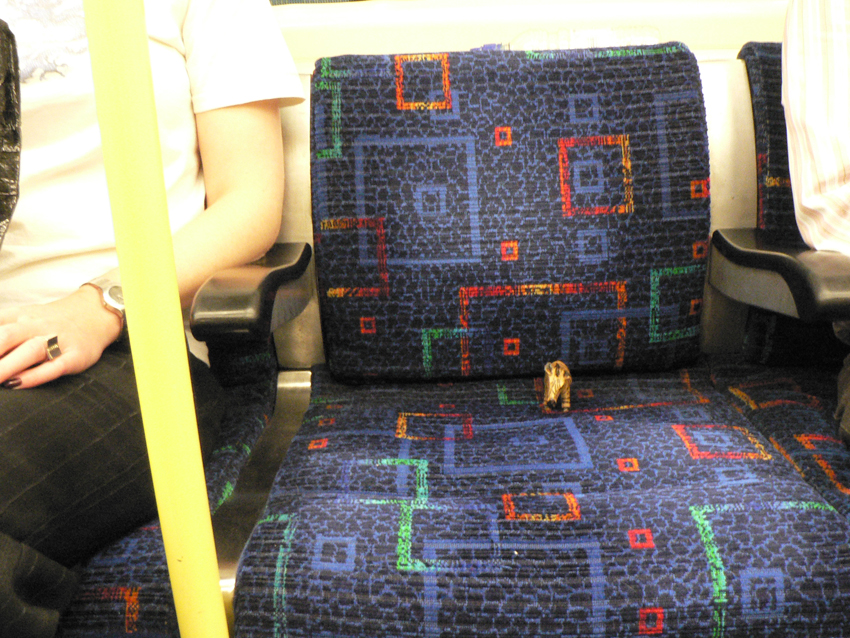
After that evening we worked together on a portfolio of photographic prints for a performance workshop that I had conducted at the Bag Factory. Just as this project was winding up Mika and I heard that we would be coming to London. We held a small farewell party in Johannesburg. As we left that evening  he gave us both a sincere hug and I remember his arm stretching over my neck and grasping me tightly for the briefest of moments. He plonked a little wooden Zebra into Mika’s hands and said to take it along as a remembrance. He also said that it belonged to a small group of animal figurines that he kept at home and that if we did not take the Zebra to London we should give it back immediately. And this is how, of all the otherwise useful things we could take along on our journey, the Zebra also made it.

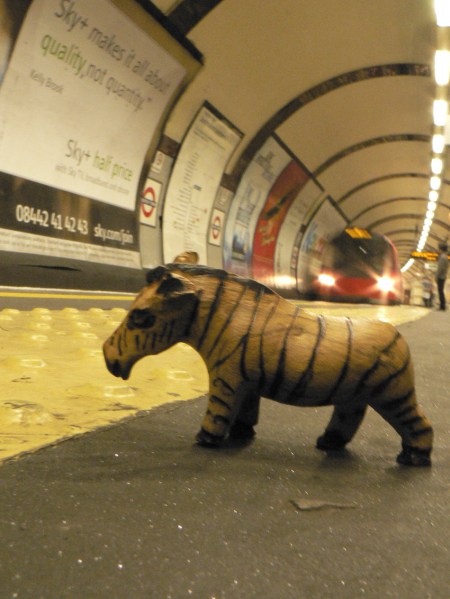
A few months later we took a photograph of the Zebra next to the train tracks at the tube in Kentish Town. Mika and I laughed as we thought of sending John the picture accompanied by a silly caption like ‘Culture in transit’. Mika emailed pictures but he never replied.

Now John is dead. But still I look forward to seeing him again. Perhaps he is simply waiting on another platform for another train. I really wish I had more time to know him better. Life is not fair.

Read Full Post »

Curated by Kisito Assangni

29 April 2012
7-10pm

ARENA 1 GALLERY
3026 Airport Avenue
Santa Monica – Los Angeles
CA 90405 USA

In collaboration with Manipulated Image

Including
Jude Anogwih | Younes Baba-Ali | Saidou Dicko | Ndoye Douts | Kokou Ekouagou | Mohamed El Baz | Samba Fall | Nicene Kossentini | Kai Lossgott | Michele Magema | Nathalie Mba Bikoro | Johan Thom | Saliou Traoré | Guy Woueté | Ezra Wube


Project [SFIP] is a multi-national exhibition process and a platform for critical thinking, researching and presenting African video art.

The technocultural revolution has democratised cultural and artistic practice through everyday access to new media.  At the same time, the pervasive presence of technology in our lives has raised questions around privacy, surveillance and ownership, the dominance of Western media in globalisation, as well as the privilege of access in the developed world.  The [SFIP] network is dedicated to the diffusion of new experiences worldwide through film and video.  It is unfortunate that contemporary African art remains largely associated with sculpture and painting.  Much work remains to be done in adequately researching the creative energy of the continent, especially within the last decade.

This exhibition presents a selection of African video art that stands beyond the clichés that remain associated with the dark continent and the postcolonial image. It seeks to bring viewers closer to idiosyncratic readings of African video art and its thematic concerns which are largely ignored. ‘Still Fighting Ignorance & Intellectual Perfidy’ contextualises African video art within a larger cultural framework.

Reflecting an age of inter-cultural migration, [SFIP] presents African video artists who live in Africa, Europe and USA whilst providing a meeting point for knowledge and interest in the relationship between self and society.  Most works address issues of alterity, identity, tolerance and social relationships as artists reflexively consider their sense of place and belonging in an increasingly interconnected world.

From experimental video to short film, this show focuses on aesthetic and methodological perspectives of fighting ignorance and intellectual perfidy in contemporary African art.  The project tells Africa’s story by African new media artists as seen through the lens of the relation between tradition and modernity.

Read Full Post »

UNIVERSITY OF JOHANNESBURG ART GALLERY

invites you to the opening of the exhibition entitled

Mine:

A Selection of Films by South African Artists

Date:

Wednesday 7 March 2012

Time:

18:30 for 19:00

Venue:

UJ Art Gallery

Kingsway Campus,  Corner of Kingsway Avenue and University Road Auckland Park

Bridget Baker, Dineo Seshee Bopape, Doris Bloom, Jacques Coetzer, Teboho Edkins, Simon Gush & Dorothee Kreutzfeldt, William Kentridge, Donna Kukama, Michael McGarry, Nandipha Mnthambo. Zanele Muholi, Cedric Nunn, Robin Rhode, Berni Searle, Lerato Shadi, Penny Siopis, Gregg Smith, Johan Thom, Minette Vari

UJ Arts and Culture presents an exhibition entitled Mine at the UJ Art Gallery during March 2012.  This exhibition, with a selection of nineteen films by prominent South African artists, addresses not only the concept of deep level mining, but also that of personal ownership and  the countless ways in which the self is identified and positioned.

The diverse works chosen by Berlin based curator Abrie Fourie for this show all have a common denominator: the artists make references to themselves in their work – either in person, as actor, model, observer, interviewer or instigator.

Furthermore, some of the artists such as Johan Thom, Bridget Baker, Robin Rhode, Teboho Edkins, Doris Bloom and Gregg Smith presently live in European capitals, while South African based artists enjoy an increased presence in the global art world.   Their various approaches are thus colored by local and diasporal perceptions, but they all nonetheless seek answers pertaining to aspects of identity from a perspective on South African concerns.

Capitalist exploitation, colonialism, the social, political and cultural realities of the country, history and memories are addressed by artists such as William Kentridge (nine of his videos produced between 1989 and 2003 will be on show and we get to meet Soho Eckstein again), Penny Siopis (Obscure White Messenger:2010) and Bridget Baker (Steglitz House: 2009 – 2010), while Minette Vári, for instance,  in her production (Alien:1998), positions herself in the cultural archive of the new South Africa during the period 1994 to 1998.

The film and video productions with their often experimental styles are described by Anna Schrade from the University of Bayreuth as seeking “… to represent the experience of living between two or more cultural regimes of knowledge and explore the myriad ways in which we identify and position ourselves in a world where “mining the self” is imperative for the formulation of new and alternative identities, histories and discourse” (2011).

Fourie, who conceptualized this exhibition, is an artist, photographer, curator and art facilitator.

This exhibition was first shown at the University of Bayreuth in Germany last year, and at the Dubai Community Theatre and Arts Centre in the United Arab Emirates earlier this year.

A booklet providing more insight into each of the works will be available at the exhibition.

Discussion and walkabout:

Saturday 17 March 2012 at 11:00.

Gallery hours:

Mondays to Fridays:  09:00 – 18:00

Saturdays: 09:00 – 13:00

Closed on Sundays and Public Holidays

Contact:

0115592556 | gallery@uj.ac.za | 0115592099

The exhibition ends 28 March 2012.


Read Full Post »

« Newer Posts - Older Posts »