Feeds:
Comments

Double-Body--Invite-2

Press Release

The Double Body: being in space is an exhibition of new and recent installation and performance art by South African artists and explores the implicit relationship between physical performance, or presence, and architectural spaces.  Drawing from a body of recent writing that makes a case for a corporeal “knowledge” of space, the works in this exhibition are invested in how the body locates itself in space and develops a sense of place, how installation environments may bear the traces of bodily presences and the different levels at which a viewer experiences an artwork. Many of the works, Alexander Opper’s installation, Auseinandersetzung, in the upper-level of the gallery, for instance, consist in an immediate sensory encounter for the viewer that takes place prior to a formal or analytical engagement with the work.
Nevertheless, each contribution to the exhibition has been rigorously conceived and carefully chosen to create an immersive network of spatial environments that exist in a carefully hewn poetic conversation with each another.  This conversation will ring most clearly at the exhibition’s opening event, where Lerato Shadi, and Bronwyn Lace will present performance works and new video work by Nina Barnett, Same Seine, will be projected onto an outdoor “screen”.  This exhibition has been designed to read best after dark, and uses unconventional lighting selected to meet the display demands of each work individually.  In this way, the exhibition breaks with the temporal conventions of gallery viewing and relies on its external environment to determine the conditions of its legibility and meaning.
Participating artists are Marcus Neustetter, Bronwyn Lace, Alexander Opper, David Andrew, Nina Barnett, Johan Thom, Lerato Shadi, Phillip Raiford Johnson, Murray Kruger and Rodan Kane Hart.
Curated for the FADA Gallery by Anthea Buys.
A digital catalogue will be available from May 20 on the FADA website.

Opening: FADA Gallery, Johannesburg, Wednesday May 20, 6.30pm.
Contact: Andthea Buys
antheabuys@mweb.co.za; 082 460 3427
With thanks to Leora Farber, Lauren van der Merwe, Gordon Froud, Rosalind Cleaver, David Paton, Lucille Pillay and Avita Padiachey.

FADA_Directions_Map

Konzerte & Vorträge im Iwalewa-Haus, Afrkazentrum der Universitat Bayreuth

Violence and Happiness: The body as force, surface and linkage

Vortrag & Videopräsentation von Johan Thom

Johan Thom, einer der profiliertesten südafrikanischen Performance-, Installations- und Medienkünstler berichtet über aktuelle Projekte, an denen er zurzeit in London arbeitet und stellt einige seiner früheren Arbeiten selbst vor, u.a. aus der Serie “Pencil Test” (2003), “Theory of Evolution” (2006) und aus der Serie “Outpost” (2004-2008) (mehr unter: www.johanthom.com).

Mittwoch 27. Mai um 19 Uhr, Seminarraum

‘Dystopia’

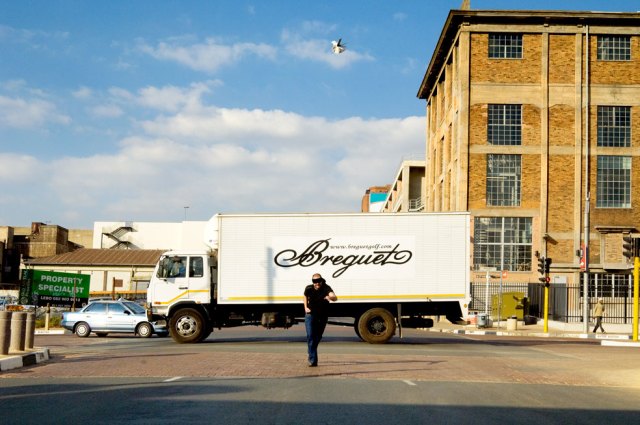
Still from Vox Populi/ Vox Dei (Credit: Hans Wilshcut)

Photographic still  from ‘Vox Populis Vox Dei’

PRESS RELEASE: ‘DYSTOPIA’

Dates & venues:

May 23 – June 30, 2009: Unisa Art Gallery, Pretoria
October 8 – November 15, 2009: Museum Africa, Johannesburg
June 10 – August 8, 2010: Oliewenhuis Art Museum, Mangaung
October 17 – November 21, 2010: Jan Colle Galerij, Ghent

Curator: Elfriede Dreyer
Associate professor, Department of Visual Arts
University of Pretoria
Contact: +27 832712342 (mobile)
elfriede.dreyer@up.ac.za

Assistant curator: Jacob Lebeko
Assistant-curator, Unisa art gallery
University of South Africa
Contact: +27 12 4296255
lebekj@unisa.ac.za

Participating artists: Adelle van Zyl; Brett Murray; Celia de Villiers; Christiaan Diedericks; Christiaan Hattingh; Churchill Madikida; Collen Maswanganyi; Dale Yudelman; Daniel Halter; Diane Victor; Dineo Bopape; Elfriede Dreyer; Frikkie Eksteen; Guy du Toit & Iaan Bekker; Gwenneth Miller; Jenna Burchell; Jan van der Merwe; Johan Thom; Kai Lossgott; Karlien de Villiers; Kudzanai Chiurai; Lawrence Lemaoana; Minnette Vári; Moshekwa Langa; Nicholas Hlobo; Pieter Swanepoel; Steven Cohen; Thando Mama; William Kentridge, Claire Gavronsky & Rose Shakinovsky; Zanele Muholi

Art often serves an observational, analytical and interpretational purpose. Both art’s mimetic function and its imaginative aspect provide powerful means by which any society can introspect, investigate and visualise itself as a capsule of the socio-cultural and political status quo.
Within the geographical boundaries of Southern Africa, Dystopia explores the relationship of contemporary art production to society and ideology, and aims to unmask articulations of dystopia within this cultural framework. A main curatorial intention with the exhibition is to express the view that the dystopian artworks included in this exhibition and the cultural criticism articulated therein seem to have responded to an air of crisis that has been pervading contemporary thinking for several decades now.
In principle, dystopian texts express world views that postulate end-of-utopia, utopia-gone-wrong and even anti-utopia, and entail responses to and a critique of utopia. In the dystopian genre the imagination is tweaked as a critical instrument set on deconstructing existing or potential ills, injustices and hypocrisies in society, mainly brought on by utopian ideologies and legacies. In dystopian texts — whether real or fictive; visual or literary — stories are told about, for instance, societies and places where the impact of the ideological blueprint of globalisation has created diasporic cultures and nomad identities; about unjust utopian political ideas that create social restriction, impaired mobility, repression or oppression; or about postutopian space and loss of religious belief and direction. It might recount posthuman conditions as a result of the dominating influence of the technological utopianism, evident in dysfunctional cyberrelationships and telematic influences leading to rampant violence, threat to self, insensitivity and indifference to critical socio-cultural problems.
Broadly speaking, Dystopia deals with the following themes: political utopia-gone-wrong; teleology and apocalypse; dystopian contestations of gender, race and culture; spatiality and boundaries as postideological zones; the postindustrial city; and technodystopia. The artworks that have been selected for the exhibition function as palimpsests where dystopian maps have been superimposed over utopia, but also as utopian constructions where dystopian realities have been absorbed, negated and transcended in order to generate a new utopian synthesis.
A significant metatext in the conceptual architecture of the exhibition is the role and use of various kinds of technologies from low-tech to high-tech digital tools in the production of the artworks. The objective here is to come closer to an understanding of the way in which culture produces itself and attributes meaning to that self-production. The appropriated technologies reflect social processes, histories and conditions in South Africa and as such provide a kind of technological “barometer” for, for instance, rural village settings, inner city diasporic communities and consumer environments.
The exhibition consists of a combination of recently and newly produced work of South African artists, both emerging and internationally acclaimed, as well as selected artworks from the University of South Africa’s art collection.
A comprehensive catalogue and an educational programme accompany the exhibition. There will be walkabouts on Friday, May 29, and Friday, June 19, at 13h00. A panel discussion will take place in the Unisa Art Gallery on Saturday, May 30, from 10h00 to 13h00.
Dystopia is primarily funded by the National Research Foundation of South Africa under the Key International Science Capacity (KISC) Initiative, as well as by Unisa.

hands-dv3

PANOPTICON

Artist: Johan Thom
Date: 2008
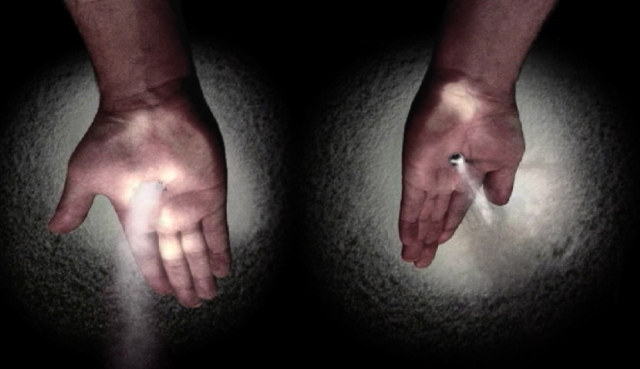
Medium: Installation: Video projection on mounds of salt, glass
Sizes: 125 x 120 x 45 cm approx

For this project I thought specifically about the notion of distance, of looking outward into space as a means of establishing a provisional locus. The exteriority of this locus is questioned and rendered ambivalent through the disappearing body: the gaping wound that makes of Saint Thomas a believer in a transcendent body.

Final display:
The final work will be projected vertically, with the projector wall-mounted facing downwards and the projected image falling onto two small mounds of salt (laying on two separate half-round glass shelves also wall mounted with brackets).

The work will be exhibited in 21-23 January 2009 at the Slade Research Center, Woburn Square, London as part of ‘The view from here’ – a collaborative project between UCL’s Slade School of Fine Art, the Bartlett School of Architecture and the BBC. The project is part of the annual ‘Research Spaces’ collaboration between the PhD students from each school. For the 2008/9 edition the project explores notions of cultural translation and trans-positioning by artists working in different media drawing from the three key project terms – transmit, translate, transmute.

Visit project site: http://researchspaces-tvfh.com/

The work was made with technical assistance by Justus De Jager, Director of Photography, http://justusdejager.com/Home.html