Feeds:
Comments

Archive for the ‘News’ Category

The Slade School of Fine Art (UCL) invites you to

‘Spillage’

An exhibition of works produced by current PhD students

Venue: The Slade Research Centre, Woburn Square, London, WC1H OAB
Private View: Friday 25 June from 6pm
Dates: 25 – 30 June
web: http://www.ucl.ac.uk/slade/index.php

Read Full Post »


Fried Art presents: Games People Play (a group exhibition of South African Artists)

Preview on Thursday 17 June at 18h30 by Dr Franco Colin

Music by Bongi Nthombeni

June 2010, the ears are numbed by the cacophony of vuvuzelas in the crowded South African soccer stadiums. What’s happening on the field is what does justice to the idea of GAME. Yet, such formalised games are often only a mild version of the kind of games that are played out in the human arena of political, social, personal and business games, agendas and encounters.  These games are ongoing; there’s plenty at stake and much tug of war.

During the 1960s, game theory became a popular study of the way in which human beings operate and compete especially in the fields of computer science, politics, agriculture and economics. Game theory has proven instrumental in understanding how and why decisions are made. Games People Play (1964), a groundbreaking pop psychology book by Eric Berne, introduced the notion of such human gaming based on Freud’s psychodynamic model, particularly the ego states, as a psychology of human interactions called “transactional analysis”. According to Berne, games are ritualistic transactions or behaviour patterns between individuals that can indicate hidden feelings or emotions.  In a general sense it can be argued that human encounters involve mind games in which people interact through a patterned and predictable series of “transactions” that are superficially conceivable, but sometimes could mask hidden agendas.  Berne (Butler-Bowden 2007) came to the view that within each person were three selves or “ego states” which often contradicted each other. They were characterized by the attitudes and thinking of a parental figure (Parent); the adult-like rationality, objectivity and acceptance of the truth (Adult); and the stances and fixations of a child (Child). The three selves correspond loosely to Freud’s superego (Parent), ego (Adult) and id (Child). Berne (Butler-Bowden 2007) further argued  that we teach our children all the pastimes, rituals and procedures they need to adapt to the culture and get by in life, and spend a lot of time choosing their schools and activities, yet we don’t teach them about games, an unfortunate but realistic feature of the dynamics of every family and institution. The book spawned a well-known song by the same title written, composed and performed in 1968 by singer/song-writer Joe South.

During the eighteenth century, a game called “stag hunt “was developed by philosopher Jean-Jacques Rousseau. This game, also known as the assurance game, involves making a choice between individual safety and risky cooperation and involves the idea that two hunters who must decide whether to hunt a hare alone or a stag together.  ‘Arguably, the stag hunt describes the ethical dilemma of the scientists who built the atomic bomb. Roughly: The world would be better off without the bomb, but we have to try to build it because our enemy will. Better we have the bomb than our enemy; better both sides have the bomb than just our enemy’ (Poundstone [s.a.]).

In an interview with Arthur Holmberg, Milan Kundera (1985) stated: ‘ … playing games is an important source of pleasure. Real life is linked to a series of deceptions. It disappoints us with its futility. But when we consciously play games, as on stage, we already know that the game is not serious. Thus, the tragic futility of life becomes the joyous futility of play. In totalitarian regimes one quickly learns the importance of humor. You learn to trust or mistrust people because of the way they laugh. The modern world frightens me because it’s rapidly losing its sense of the playfulness of play.’ The playing of games can provide various satisfactions: aggressive and masochistic; expectant readiness with contempt of danger and consequent mastering of situations; repeated endurance of symbolic castration with resurrection of potency when one wins (Stokes 1956).

Accordingly, the “games” people play form the core of the subject matter in the works on display in Games people play.  The artworks on exhibition comment on the playing of games through a patterned and often predictable series of “transactions” that might not be superficially conceivable, but mask secret motives, feelings or emotions. Similarly, there are many word games, echoed in the game of the “language” of the artwork that is open-ended and  often cloaked in metonymy. The philosopher Wittgenstein maintained that words have a “family” of usages and resemblances: the word “game”, for example, could indicate board games, card games, virtual gaming or soccer games. Such games do not hold a single critical mutual attribute, but rather possess common characteristics and similarities.

Fried Art

http://www.friedcontemporary.com/

430 Charles St Brooklyn, Pretoria, South Africa 0181

TEL/FAX:   +27 12 3460158

E-MAIL

General information and art courses: info@friedcontemporary.com

Exhibitions and artists: art@friedcontemporary.com

Sources quoted

Butler-Bowden, T. 2007. 50 Psychology Classics: Who We Are, How We Think, What We Do: Insight and inspiration from 50 key books. Nicholas Brealey Publishing, 2007 . [O] Available: http://knol.google.com/k/games-people-play#. Accessed 14 June 2010.

Poundstone, W [s.a.]. Excerpts from Prisoner’s Dilemma. [O] Available: http://www.heretical.com/pound/staghunt.html. Accessed 14 June 2010.

Stokes, A. 1956. Psychoanalytic Reflections on the Development of Ball Games, Particularly Cricket. International Journal of Psychoanalysis. XXXVII:185-192.

Kundera, M. 1985.  Interview with Arthur Holmberg. Performing arts journal, Volume 9, 1:25-27.

Read Full Post »

D21 Kunstraum  Leipzig

PRIVATE VIEWING – SOUTH AFRICAN VIDEO ART

Steve Kwena Mokwena. Memory
Bridget Baker
Peter Jones
Aryan Kaganof & Nicola Deane
Kemang Wa Lehulere
Steve Kwena Mokwena
George Mahashe
Kyle Southgate
Johan Thom
Robert Weinek
+ Claudia Shneider

Steve Kwena Mokwena, THE MEMORY OF THE BRIDGE, (Still) 2010
Exhibition in Cooperation with JOBURG FRINGE, ZA.

June 12 – 25, 2010
Opening: June 11, 2010, 7 p.m.
Opening hours: Thu – Sun, 1 – 7 p.m.

D21 art space | Demmeringstr. 21 | D-04177 Leipzig | Germany | www.d21-leipzig.de


Read Full Post »

–––––––––––––––––––––––––––––––––––––––––––––––––––––

––––––––––––––––––––––––––––––

–––––––––––––––––––––––

invites you to
–––––––––––––––––––––––––––––––––––––––––––––––––––––
–––––––––––––––––––––––––––––––––––––––––––––––––––––

JOHAN THOM


HANS WILSCHUT

–––––––––––––––––––––––––––––––––––––––––––––––––––––
–––––––––––––––––––––––––––––––––––––––––––––––––––––
Exhibition runs 4-18 June 2010
Opening Friday June 4 2010, 8pm
Accompanied with a performance by Johan Thom
–––––––––––––––––––––––––––––––––––––––––––––––––––––
–––––––––––––––––––––––––––––––––––––––––––––––––––––

De Zwarte Ruyter is pleasured to announce a exhibition by
Hans Wilschut and Johan Thom.

In 2008 Johan Thom (1976 Johannesburg) and Hans Wilschut (1966

Ridderkerk) collaborated on various projects. Now their ongoing
friendship and professional dialogue brings them together in
Rotterdam in an exhibition influenced by each other’s work and
interests. Wilschut’s video work ‘Lemniscate’ will be exhibited in one
area of De Zwarte Ruyter. In another area Thom will create a
performance in part as a response thereto and in part as an extension
of their ongoing dialogue.
Wilschut’s newest book publication “Still Motion” will be also be
available for signing by the artist.

–––––––––––––––––––––––––––––––––––––––––––––––––––––
–––––––––––––––––––––––––––––––––––––––––––––––––––––

De Zwarte Ruyter is a new research and presentation space for
contemporary art and visual culture which wants to take a precise
role within the Rotterdam art world and far beyond. De Zwarte Ruyter
operates from the belief that new expressions of art, the development
of new or alternative ideas can best be developed in a free and
informal but critical environment. Additionally De Zwarte Ruyter is
home to BookCase a bookstore for artist books, publications, editions
magazines which are published by the artist without a publisher.

Be very welcome and for additional information please contact
De Zwarte Ruyter.

/

De Zwarte Ruyter
Van der Takstraat 107
3071LK Rotterdam
The Netherlands

Opening times
Wednesday to Saturday
12.00 – 18.00 and by appointment

T:   06 12106383
E:   info@dezwarteruyter.net
W:  dezwarteruyter.net

Read Full Post »

Read Full Post »

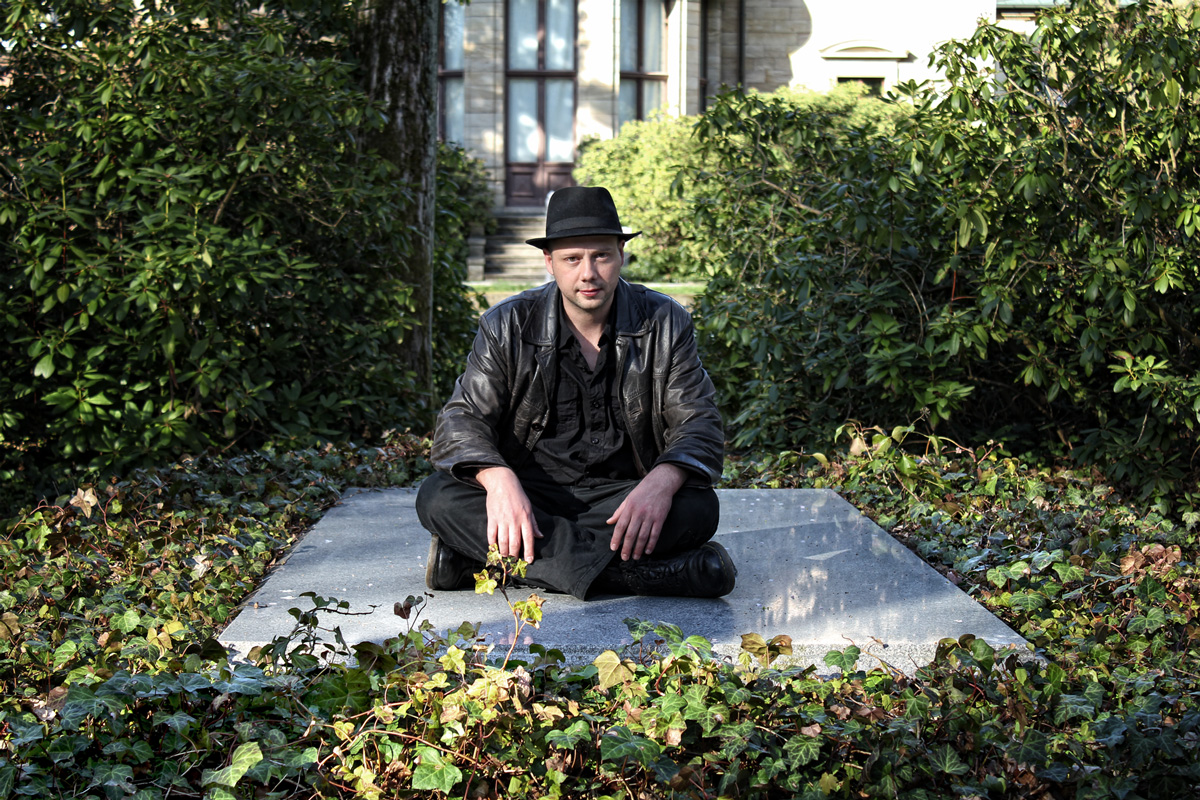
Lid/ Self-portrait


LID/ SELF-PORTRAIT At the beginning of my period of study in London I decided to wear a hat and only the color black, every day for three years. I wanted to establish a definite, though unobtrusive marker through which this period could be ‘framed’. In hindsight it is interesting to see how such a small change in my appearance would modify my artistic practice and general experience of life. This decision had some definite, immediate consequences as I could, for example, not enter into churches and was even turned away from nightclubs without having to remove the hat. The hat would become a prominent feature of many of the artworks produced during the time.
In this way the self-portrait on Wagner’s grave is something of a double ‘lid’ upon a container: that of the gravestone as well as that of the hat upon my head. Both signal clear divisions between the various material states of being in time. I stopped wearing the hat and the colour black every day of the performance in Bodh Gaya, India, entitled ‘Thank You’ (14 February 2011). On the next page is an interview regarding the work I gave as part of an online exhibition entitled ‘Opening Borders/Opening Objects’, curated by MA/MFA/PHD students of, and hosted by, the University of Western Ontario, Canada, 1 May – 30 August 2010.

Q: Where did you get the object from?
(Please include the city and the venue)
JT: I purchased it at approximately 14h00 on Friday 29 September 2009 at a hat stall in Camden Lock Market, London, UK.

Q: Was the souvenir a gift, a purchased object, or a found object?
JT: Purchased, found object. (Even if you find an object one often still has to pay for it).

Q: If you purchased the object, how much did it cost?
JT: 35 Pounds sterling.

Q: What made you select/keep the object?
JT: When I moved to London from Johannesburg I felt that I wanted to change my appearance by wearing only black  for the duration of my stay. Prior to this I had done a number of performance artworks wearing white workers uniforms. In some way I consider the change in my appearance indicative of a new phase in my work and life. Moreover I wanted to more fully integrate the performative aspects of my work into my everyday life without making it too obvious. I felt the hat fulfilled a multiplicity of roles here:
One, it suggested something about the notion of empire (the gentleman, the English bowler hat);
Two, it effectively covered my head, stopping the natural flow of energy both in and out – thus it could function as something of a lid on an otherwise open ‘container’;
Three, it is functional in that it allows the body to retain much of its heat in the cold weather of the UK (especially since I regularly shave my head).

Moreover, on account of my wearing the hat I was refused entry (or requested to remove it if I wished to stay) at two sites during this period:
22 January 2011, 11h34 – Cologne Cathedral, Cologne, Germany. After entering the space a priest asked me to remove the hat. I politely declined
and left.
25 September 2010, 22h14 – The My Hotel Bar at
My Hotel, Brighton, UK. The bar has a ‘no-hat’ policy and would not allow me entry despite the fact that
I was lodging at their premises.

The hat has also featured as an integral component in a number of artworks produced during this time. These include ‘blood rites/ eat your words’ (2010)
and ‘Prospecter’ (2010), amongst others.

Lastly, I will stop wearing the hat at the end of my period of studies in the UK (I am currently completing a PhD at the Slade School of Fine Art, UCL on a Commonwealth Scholarship).

Q: Is there anything else that you would like to tell us about your souvenir?
JT: On the inside of the hat the following inscription can be found:  “100% Wool. Handmade. Made for England”.


Read Full Post »

Iwalewa-Haus

Johan Thom

becoming, binding & disappearing – a selection of video works

Apr 22nd – Sep 5th 2010

curated by Dr. Ulf Vierke

Iwalewa Haus (The Africa Center of the University of Bayreuth)

Münzgasse 9
95444 Bayreuth, Germany
Tel: +49-921-554600

http://www.iwalewa.uni-bayreuth.de/

Johan Thom is a South African visual artist working with the body as primary subject material. This is the first time that a comprehensive selection of his video works and video installations are shown together.

Well known for his performances, videos and video installations Thom often subjects the body to extremes in a quest to map its ongoing transformation. His works are both enigmatic and playful, subverting preconceived notions about identity, the body, politics and knowledge.

Thom is part of a generation of South Africans born in 1976, the year of the Soweto riots and the introduction of television in South Africa (a group that also coincidentally exercised for the first time their right to vote in the democratic elections of 1994). This generation of South African artists stand precariously balanced between the past and the present of South African society, its culture and history. In this regard Thom’s works do not fit comfortably into the celebratory mould of the ‘new’ South Africa but, rather, is anchored in a constant personal movement through – and exploration of – the contradictory poetics and politics of being a ‘white-male-Afrikaans-speaking-African’. His artistic position here is that of an individual perhaps somewhere between a modern day shaman and a traditional court jester. The result is a darkly humorous and provocative artistic exploration of the relationship between subjectivity, knowledge and the body.

The exhibition includes a number of large-scale video projections and installations such as Challenging mud after Kazuo Shiraga (2008), a video projection displayed on a thin layer of flour placed on the floor and showing the artist being buried alive with his body covered in gold leaf; Theory of displacement (2007/8), a massive immersive environment consisting of three video projections in which the artist lies tarred and feathered in a natural spring situated in the area known as the ‘Cradle of Humankind’, South Africa; Terms of endearment (2007) in which the artist made up in ‘skullface’ happily gargles on ordinary washing detergent and champagne. Also included on the exhibition is a new large-scale installation titled Blood Rites (2010) showing the extreme close-up movement of the artist’s face covered in gold leaf as he ritually places 50 individually engraved razor blades in his mouth, chewing and spitting them – all projected onto a number of thick rope lengths hanging from the ceiling.

This solo exhibition is supplemented by the screening of Terrorizing the concept of meaning – Conversations with Johan Thom, a 43-minute documentary film produced by Iwalewa Haus & the Federal German Research Council and made by Thorolf Lipp and Tobias Wendl following extensive interaction with the artist over the course of the past two years.

Venue: Iwalewa Haus, Münzgasse 9, Bayreuth, Germany

Vernissage: 19h00, 22 April 2010

Artist talk: 19h00, 23 April 2010

Opening Hours: Tue – Sun 14h00 – 18h00

Dates: 22 April 2010 – 05 September 2010

Contact: iwalewa@uni-bayreuth.de

Read Full Post »

Johan Thom - sequence of stills from performance as part of 'Tables of Thought'

DECOY 2010, Performance, Text, razorblades, projected images, ladder, speaker. Performance held as part of ‘Tables of thought’ exhibition and seminar organized by the European Arts and Research Network and hosted by the Finish Academy of Arts
28-29 April 2010, Finland, Helsinki

_____________________________________________________________________________________________________________________________
DECOY A bird or animal, or an imitation of one, used to attract others. Also a person or thing employed to entice or deceive others into capture, danger, error, etc.; a swindler’s confederate; a tempter; bait, an enticement (decoy-duck; decoy ship: used to decoy enemy vessels).

For this work, I presented a performance-lecture that combined the body’s physical action with the reading of text and the moving image. Each word was engraved on a single razorblade and read aloud from atop a ladder during the performance. My body physically cut into the projected image.

The sequence of projected images that accompanied the reading was drawn from found footage capturing the exact moment when a duck is shot over a lake. However, the sequence of images is reversed.

Once the reading was complete all the razorblades, or words, were collected with a speaker partially covered with gold leaf and placed upon the speakers’ podium.

Location: KUVA, Kaikukatu 4, Helsinki, Finland.

For more information: http://www.kuva.fi or h

_____________________________________________________________________________________________________________________________

Text for DECOY 2010, Performance, razorblades, projected images, ladder, speaker. Performance held as part of ‘Tables of thought’ exhibition and seminar organized by the European Arts and Research Network and hosted by the Finish Academy of Arts 28-29 April 2010, Finland, Helsinki

it feels like forever
this weightless moment
that has me fobbing about
as if I never even learned the basics
much worse than sounding like a fool
this spastic nowhere acrobatics
ruffled feathers
head over heels
a common tumbler
sun horizon sun veld
oh look: it’s the hills!
sun sun
solid ground approaching fast
at least when they kicked me out of the nest
I still made a show of resistance
even if it were completely futile
just one decent flap!
before I go digging up daisies
right next to that coocooing stiffneckbird
that duped me so
vlieg fokker vlieg!


enri.wegelius@kuva.fi

Read Full Post »

Dr Sharon Morris & Jon Thomson, Slade School of Fine Art

Slade Word/Image Forum presents Off the shelf: performance, film, video, poetry music.  An evening of live events staged by the Slade School of Fine Art, UCL, to take place in the Wilkins North and South Cloisters plus the Old Refectory at UCL’s Gower Street Campus, 22 March 2010, 6.00-10.30p.m.

Taking as its theme a re-examination of the Small Press Collection of rare magazines housed at UCL, this event will give you the chance to engage with the spirit of the alternative ‘avant-garde’ press, re-visiting early texts that straddle the divide between art and poetry — including artists and writers Vito Acconci, Sol Le Witt, Ian Hamilton Finlay, Derek Jarman and Bob Cobbing. These texts will be explored through various forms of performance and accompanied by film, video and documentation of the period.

The evening will also stage new creative works by contemporary visual artists, writers and musicians, exploring the interaction between words and images and a ‘speaker’s corner’ with short talks by members of the Slade Word/Image Research Forum.  This is one of a series of public events planned by the forum for 2009-2011.

Read Full Post »

Hannah Höch Flight 1931, Collage, 23 x 18.4 cm

Apparently I have a work on this exhibition… should be a very interesting show regardless of whether you spot it or not*.

‘Dada South?’, curated by Roger van Wyk and Kathryn Smith presents a collision of artistic strategies and forms that reflect the impact of Dada; works conceived and enacted in the spirit of Dada, and which seek to question the conventions, values and function of art in a troubled society. The juxtaposition of works from South Africa and from abroad, aims to examine the significance of non-western cultures in Dada practice. It also provides an opportunity to consider an alternative history of resistance in a culture of isolation and repression in South Africa, one that intersects with the canon of ‘resistance art’, but which deviates into forms that are less didactic, more eclectic and experimental.

On exhibition will be historical Dada works and publications by Marcel Duchamp, George Grosz, Raoul Hausmann, John Heartfield, Hannah Höch, Man Ray, Hans Richter and Sophie Täuber-Arp are assembled for exhibition alongside works and objects by Jane Alexander, Walter Battiss, Willem Boshoff, Candice Breitz, Kendell Geers, Neil Goedhals, Wopko Jensma, Robin Rhode, and Lucas Seage among many others.

The opening features a series of performances by Warrick Sony, Donna Kukama and Kemang wa Lehulere and the Iziko Museums Education and Public Programmes, among others.

The work on display is the modified Afrikaans dictionary from ‘words oft error’ (2005)

Dates: 12 December – 28 February

Read Full Post »

« Newer Posts - Older Posts »