Transcript of the keynote conversation between Willem Boshoff and Olu Oguibe at the Art, Access and Agency – Art Sites of Enabling Conference hosted by the University of Pretoria’s School of the Arts and the University of Pretoria’s Transformation Directorate from 7-9 October 2021. The conversation is introduced and moderated by Johan Thom. Published originally by Image and Text (details below).
Transcribed by Natasha Kudita
List of Acronyms:
JT= Johan Thom
WB= Willem Boshoff
OO= Olu Oguibe
JT: The artworks Garden of Words (1981 – present) by Willem Boshoff and Sex Work is Honest Work (2021) by Olu Oguibe form the basis of this discussion regarding social advocacy in contemporary art and the many material and conceptual forms it may take. Interestingly, both series of works somehow take the garden as a starting point. From here the artists proceed to map out divergent artistic terrains of social engagement and contemporary art practice.
The Garden of Words series is a mammoth, long-term undertaking underpinned by the sheer force of Willem Boshoff’s artistic labours and his ongoing interest in the power and forms of language. Throughout this series Boshoff delves into the archives of language, creation myths, plant life (and its rapid extinction), memory, and graveyards. For example, since 1981 Boshoff has identified over fifteen thousand plant species in different locations all over the world, collecting their names and memorialising them in – and as part of – a series of enigmatic sculptural forms and installations. Now in its fourth incarnation, the Garden of Words series is an ongoing act of ‘seeding’, a promise of germination at the heart of human existence on earth – this despite our seeming all-consuming penchant for destruction and self-aggrandisement.
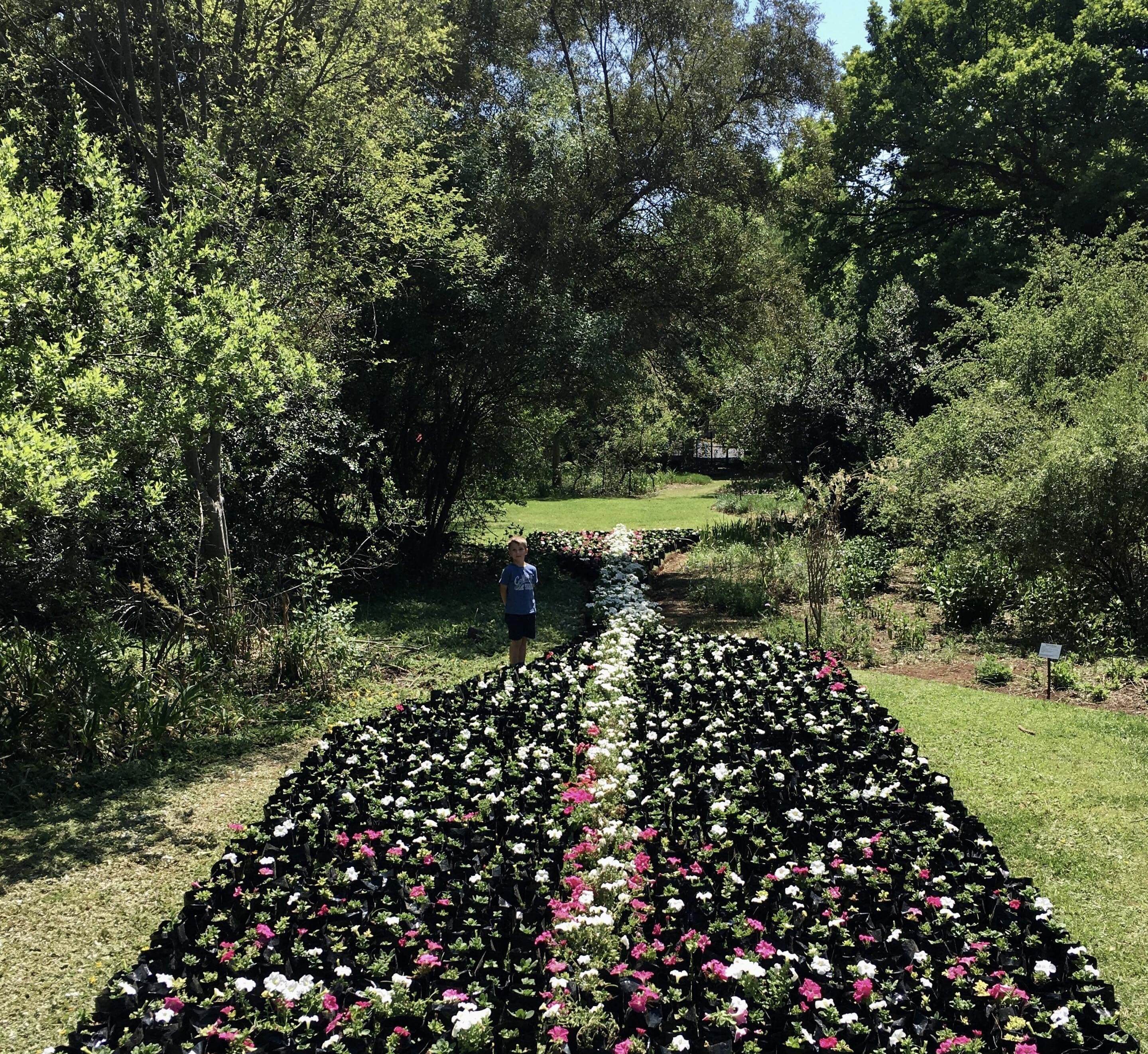
In 2018 Olu Oguibe installed the artwork, Pink and White Flowers, in the botanical garden in Potchefstroom – a transient monument-of-sorts consisting of approximately three-and-a-half thousand live flowering plants that visitors were invited to take home and care for. The work commemorated the life of a young woman named Nokuphila Kumalo. Kumalo was a sex worker who tragically died in Cape Town in 2013, allegedly at the hands of South African artist Zwelethu Mthethwa. From here, we see how Oguibe’s lifelong interests in labour and social justice converge and transform into an ongoing multifaceted art project titled Sex Work is Honest Work. This project confronts the near-global bias against the salient recognition of sex work as honest work by way of several discrete but interrelated manifestations including: A public installation in Arnhem, Netherlands, as part of Sonsbeek20-24 International Art Festival; a two-day conference jointly organised between Sonsbeek Art Festival, The Dutch Art Institute, and Oguibe in August of that year; a standalone neon sculpture for the contemporary art gallery space, and, most recently, a multi-panel text-based work on paper and resin sculpture. Each of these manifestations remains true to the central message of the work, but they embody it in very different ways.
Art is, of course, always simultaneously useless and deeply meaningful, allowing us to reflect on our failures and successes as more than mere cold instruments of purpose and reason. In other words, central to contemporary artistic practice is the recognition of viewers as being thinking, feeling, humans and individuals. Accordingly, we may be transformed if we deeply engage the uncertain space at the heart of contemporary art’s complex, even beautiful workings as a form of social practice, labour, and ultimately, of love.
Willem and Olu, would you each be kind enough to introduce the series of artworks under discussion to the audience by briefly referring to the process of their making, their different formal manifestations and conceptual underpinnings, for example?…
Read the whole conversation (open access): https://scielo.org.za/scielo.php?script=sci_arttext&pid=S1021-14972023000100026
Image credit: Olu Oguibe, installation view of ‘Pink and White Flowers’ (2018), a site specific installation at the NWU Botanical Gardens, Potchefstroom, South Africa.
 johanthom.com