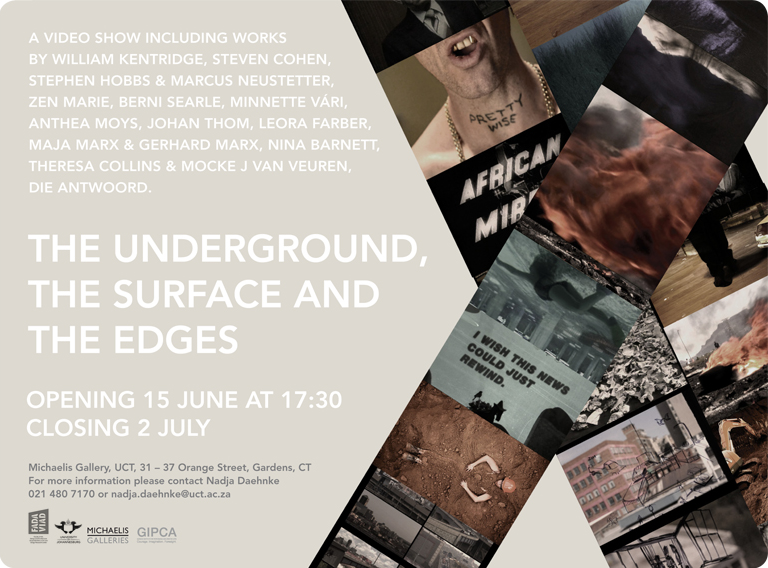
Posted in News | Tagged Anthea Moys, Berni Searle, Die Antwoord, Gerhard Marx, Johan Thom, Leora Farber, Marcus Neustetter, Maya Marx, Michealis Gallery, Steven Cohen, Steven Hobbs, William Kentridge, Zen Marie |

An exhibition entitled Map – South Africa with works from a broad spectrum of artists and genres will be hosted by the UJ Art Gallery from 11 May to 15 June 2011. In addition to showing new work by 39 artists who have participated in Map, the exhibition documents the diverse spaces utilised for the Map projects all over South Africa.
These spaces include restaurants, hotels, homes and Map’s own Karoo residency. The show also records Map participation in the 2007 Innibos arts festival and an architecture conference: African Perspectives 2009: ‘The African City Centre (re)sourced’, hosted by the University of Pretoria, as well as publications relating to these projects.
The founders of the project, patron of the arts, Harrie Siertsema and Abrie Fourie, well known artist and curator, brought a fresh and innovative approach to the domain of visual arts through this ongoing project and through their unwavering trust in and support of South African artists.
The multifaceted Modern Art Project (Map) originated in 2005 out of the impulse to combine the works of established and emerging artists and to show such works in unexpected spaces outside the traditional gallery context.
Map is emblematic of a new ‘empathetic economy’ in which the artwork is taken from the white cube gallery for more democratic dispersement, and brought back to the white cube for documentation and integration. Map also points to the destruction of the division between high and low culture.
The Map endeavours are documented in an exceptional series of “black books” available for public perusal. This informative resource is also a collector’s item as a limited edition “black box” set.
Enquiries: Annali Cabano-Dempsey +2711 559 2099
Web:
http://www.uj.ac.za/EN/artsacademy/Gallery/Exhibitions/Pages/CurrentExhibition.aspx
Posted in News | Tagged Abrie Fourie, Colbert Mashile, Diane Victor, Donna Kukama, Harrie Siertsema, Jeremy Wafer, Johan Thom, Map ZAR, Robert Hodgins, Sam Nhlengethwa, UJ Arts Center |
…Opening Borders/Opening Objects facilitates a break with the standardized form of engagement with the artist, conceived of and valued primarily as producers and typically represented by their artistic output. Through their relationship with objects circulating in different, yet connected, cultural networks and markets, the exhibition invokes and complicates perceived binaries such as producer/consumer, high/low, real/imagined and local/global, as well of notions of truth, authenticity, and value.
Posted in News | Tagged Andrea M. Lothrop, Anna Torma, Barbara Astman, Barbara Sternberg, Benoit Broisat, Bonnie Jarvis Goodden, Brett Graham, Catherine Chan, Clare Arni, David Hoffos, Ed Pien, Emilio Chapela Pérez, Ergin Cavusoglu, Fern Helfand, Fumiko Kobayashi, Humboldt Magnussen, Iris Häussler, Jack Butler, Jamelie Hassan, Janna Watson, Jean-Baptiste Bernadet, Jeff Thomas, Johan Thom, Jordan Baseman, Kim Beck, Kisoo Kwon, Kristin Calabrese, Matthias Lahme, Micah Lexier, Miles Collyer, Mladen Bizumic, Mounira Al Solh, Murali Cheeroth, Oliver Michaels, Paul Collins, Ruben Gutiérrez, Rui Calçada Bastos, Ruth Sacks, Ryan Watkins-Hughes, Sarah Oneschuk, Sophia Isajiw, Tirzo Martha, Trasi Henen, Vincent Trasov, Vivienne Jones, Zanele Muholi |
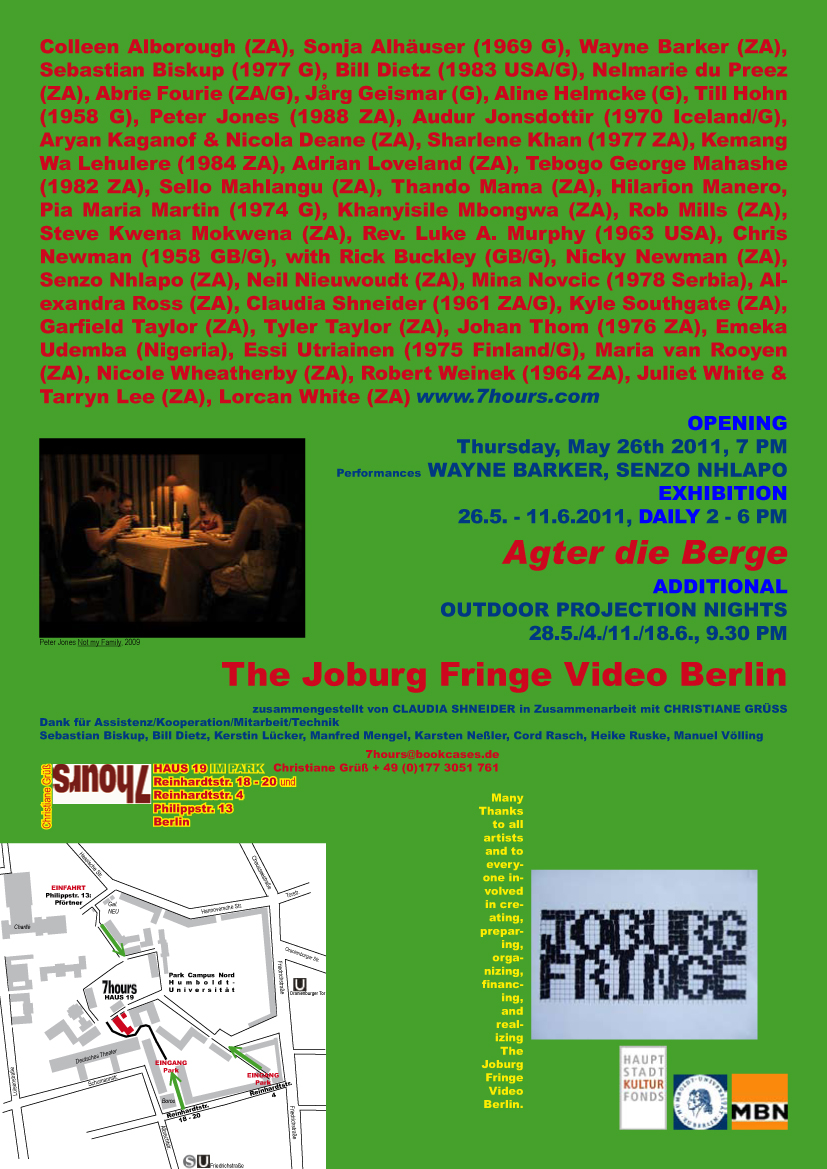
Posted in News | Tagged Abrie Fourie, Claudia Schneider, Colleen Alborough, Essi Utriainen, http://www.7hours.com/, Joburg Fringe, Lorcan White, Senzo Nhlaop, Thando Mama, Wayne Barker |

POLYply > 9 ANIMAL ANIMAL 14 April
Maria Fusco
Carol Watts
Anna Lawrence
Johan Thom
Peter Cusack
Carol Watts
Anna Lawrence
Johan Thom
Peter Cusack
Thursday 14th April, 7pm-9pm
The Centre for Creative Collaboration
16 Acton Street, London WC1X 9NG
The Centre for Creative Collaboration
16 Acton Street, London WC1X 9NG
Posted in News | Tagged Anna Lawrence, Carol Watts, Johan Thom, Maria Fusco, Peter Cusack, POLYply |

Posted in News | Tagged Ajitvar Kumar Douglas, Anna MaCleod, Artists, Dianne Hagen, India, Johan Thom, Mohammed Kazem, Peter Rokven, public art, Sanjeev Sinha, Simead McCann, Simone de Waal, Tashi Norbu, Vivek Vilasini |
SLADE SCHOOL OF FINE ART
Surplus to Requirements?
Exhibition and Symposium 2-4 March
Slade Research Centre Woburn Square London WC1H 0AB
Artists, curators and theorists respond to the cuts in arts and humanities funding with an exhibition, screenings, performances and lectures around the theme of the value of art and research – curated by the Slade School of Fine Art MPhil/PhD Group
Artists
Katy Beinart, Leah Lovett & Helen Rawling, Joanne Bristol, Becky Cremin, Fiona Curran, Michael Delacruz, Sonke Faltien, Errol Francis, Laura Kuch, Tim Long, Ope Lori, Laura Malacart, Terence McCormack, Eleanor Morgan, Sam Mould, Elaine Mullings, Aaron Murphy, Deborah Padfield, Jaimini Patel, Theresia Peng, Henrietta Simson, Slade Post Occupation Group, Kai Syng Tan, Patricia Townsend, Johan Thom with Guy du Toit, Julia Vogl, Farniyas Zaker
Speakers
Dave Beech – Artist in the Collective Freee and Chelsea College of Art & Design
Sue Golding – University of Greenwich
Mel Gooding – Art critic, writer, and curator
Jen Harvie – Queen Mary’s College
Robert Hewison – City University and Associate of think tank Demos
Sarat Maharaj – Lund University and Malmö Art Academy, Sweden
Peter Osborne – Kingston University and editor of Radical Philosophy
Open
Wed 10am-5pm
Thurs Symposium 9.30am-5pm – Exhibition late opening and live events 6-8pm
Fri 10am-1pm
RSVP: surplus@london.com
Nearest stop: Warren Street, Goodge Street or Euston Square
Posted in News | Tagged Aaron Murphy, Becky Cremin, Dave Beech, Deborah Padfield, Elaine Mullings, Eleanor Morgan, Errol Francis, Farniyas Zaker, Fiona Curran, Henrietta Simson, Jaimini Patel, Jen Harvie, Joanne Bristol, Johan Thom with Guy du Toit, Julia Vogl, Kai Syng Tan, Katy Beinart, Laura Kuch, Laura Malacart, Leah Lovett & Helen Rawling, Mel Gooding, Michael Delacruz, Ope Lori, Patricia Townsend, Peter Osborne, Robert Hewison, Sam Mould, Sarat Maharaj, Slade Post Occupation Group, Sonke Faltien, Sue Golding, Terence McCormack, Theresia Peng, Tim Long |

Johan Thom: S TEBOJ SEM
Video predavanje
Pedagoška fakulteta Maribor – risarski atelje 0.60,
Torek, 30. 11. 2010, 10:30
Johan Thom (1976) je južnoafriški umetnik, ki trenutno živi in ustvarja v Londonu. Znan je po svojih performansih, video delih, skulpturah in tekstih. Večina del je ustvaril v javnih mestnih okoljih, parkih, galerijah, pri tem pa izhajal iz vsakdanjega življenja v Južni Afriki. Trenutno raziskuje pomen materialnega v umetnosti.
»Z ozirom na materialno umetniškega dela ne moremo razumeti le kot kulturne abstrakcije ali reprezentacije, pač pa umetniško delo predstavlja performativni angažma, ki proizvaja določene pomene s prepletanjem čutov, telesnosti in razuma.«
(Johan Thom)
V predavanju bo Johan Thom razmišljal o svoji fascinaciji in uporabi zlata v seriji svojih del, v katero spada tudi video instalacija Challenging Mud (After Kazuo Shiraga), ki je na ogled v Galeriji Media Nox.


JOHAN THOM: KLJUBOVATI BLATU
Video instalacija
Galerija Media Nox
premiera 29. 11. ob 18:00, ponovitve 30. 11. in 1. 12. med 12:00 in 18:00
»Južna Afrika je moja zibelka in moj grob – kulturno, politično in umetniško. Njena rdeča prst je v mojih žilah in zgoščuje mojo kri. Ko kljubujem blatu, kljubujem svojemu lastnemu bistvu.« (Johan Thom)
23. marca 2008 je južnoafriški umetnik Johan Thom prekril svoje celotno telo z medom in zlatimi lističi za zasebni performans, v katerem so ga njegova žena in skupina najbližjih živega pokopali. V umetniškem delu, ki je nastalo, je gledalec priča, kako nevidna roka počasi prekriva zlat lik ležeč v fetusni drži na dnu groba. Delo je skorajda hipnotično, ponavljajoč zvok in gib lopate in rdeče zemlje ustvarjata meditativno vzdušje, počasna transformacija slike to še dodatno poudarja.
Kombinacija zlatega lika, zemlje in fetusne drže služi kot osnova za več interpretacijskih drž, vse navidez arhaične ali mitične v svojem bistvu: spominja nas na močvirske like severne Anglije, pa tudi inkovske in egipčanske pogrebne običaje, simboliko zlata v svetovnih nazorih ljudstva Ašanti (Afrika), uporabo zlatih lističev v renesančnem slikarstvu in azijski religiozni ikonografiji ter, bližje umetnikovemu domu, odkritju zlata v Johannesburgu, Južni Afriki.
Delo je hommage performansu Challenging Mud (1956) Kazua Shirage (1924-2008) iz umetniške skupine Guitai.
Avtor: Johan Thom, www.johanthom.com
Kinematografija: Garreth Fradgley
Asistenti: Guy du Toit, Sarel Jansen van Rensburg, Mika le Roux, Shane de Lange, Nicholas du Toit

Petra Kolmančič, koordinatorka in organizatorka kulturnih programov
Mladinski kulturni center Maribor
Ljubljanska ulica 4, Maribor
www.mkc.si www.kulturniinkubator.si
02 300 29 94
Posted in News | Tagged Johan Thom, Mladinski kulturni center Maribor |
  |
Mednarodni festival računalniških umetnosti (MFRU)
 MFRU (v organizaciji MKC Maribor) ima v Sloveniji bogato tradicijo, saj velja za eno od osrednjih institucij računalniške umetnosti, ki s svojo stalno dejavnostjo skrbi za njeno prepoznavnost in razvoj. Ob ustanovitvi leta 1994 je bil eden prvih v tem delu sveta ter prvi in edini v Sloveniji. Od svojih začetkov je v Sloveniji in širši regiji opravil pionirsko delo pri predstavljanju teorije in prakse računalniške umetnosti ter novih medijev, s čimer pomembno prispeva k njihovi promociji in uveljavitvi, hkrati pa vzpostavlja temeljno kreativno jedro – v smislu produkcije novih intermedijskih del – v tem prostoru. MFRU tako zapolnjuje pomembno kulturno programsko nišo, s čimer Maribor uvršča med konkurenčna evropska festivalska mesta.
Posted in News | Tagged Johan Thom, Performa 2010 Slovenia |

Sexuate Subjects
POLITICS, POETICS AND ETHICS
UCL, London / Friday 3rd to Sunday 5th / December 2010
This international interdisciplinary conference seeks to generate new theories and practices of subjectivity – ‘sexuate subjects’ – through contemporary poetic and political research in the visual arts, humanities and social sciences. It explores how these positive ethical subjectivities for women and men are constructed through spatial, material and textual feminist poetics and politics. Over three days, it will examine how sexuate subjects (people/disciplines) aid interdisciplinary responses to contemporary global crises of community conflict, social and environmental wellbeing. Nine panels and invited keynote speakers examine the following themes: environmental and social crises; sustainable ecologies; poetic communities, pedagogies, voices and bodies; the politics of bio-medicine, body-rights, family and well-being.
Principal Keynote:
Luce Irigaray, Doctor in Philosophy and Director of Research in Philosophy, the Centre National de la Recherche Scientific, Paris
Keynotes: Jananne Al-Ani (University of the Arts) Dr Caroline Bergvall (University of Southampton) Dr Carol Brown (University of Auckland) Dr Karen Burns (Monash University) Professor Lorraine Code (Toronto University) Professor Elizabeth Grosz (Rutgers University): video-conference presentation Professor Dorita Hannah (Massey University, Wellington) Dr Doina Petrescu (Atelier d’Architecture Autogérée and University of Sheffield)
Invited: Frederica Giardini (University Roma-Tre, Rome) FATALE (KTH, Stockholm) Dr Gillian Howie (Liverpool University) Profesor Heinz Kimmerle (University of Rotterdam) Professor Mary Rawlinson (Stony Brook University, SUNY) Dr Marita Ryan (University of Limerick) Dr Margrit Shildrick (Queen’s University, Belfast) Professor Gail Schwab (Hofstra University, Long Island NY) Professor Judith Still (The University of Nottingham) Taking Place: Feminist Spatial Practice collective Gianni Vacchelli (Universita degli Studi di Bergamo)
Please go to the Conference website for registration and further details: www.ucl.ac.uk/silva/sexuate-subjects
Funders: the Bartlett School of Architecture Research Fund; UCL’s Grand Challenge of Intercultural Interactions; Centre for the Study of Contemporary Art, History of Art Department, UCL; Department of French UCL; Slade School of Fine Art, UCL; Hofstra University; Stony Brook University and FATALE, KTH, Stockholm
…
PS: I am presenting a performance as part of this session on Saturday 4 December:
9.30-16.00 Understanding Difference: why poetry matters
Panel, performances and exhibition
Convenors: Professor Timothy Mathews (UCL), Dr Sharon Morris (UCL)
Contributors: Helen Benigson, Taru Elfving, Geraldine Finn, Jane Gilbert, Kristen Kreider & James O’Leary, Miriam Leonard, Tim Mathews, Sharon Morris, Caroline Phillips, Simone Roberts, Nastja Ronkko, Kai Tai, Johan Thom
Posted in News | Tagged Belfast) Professor Gail Schwab (Hofstra University, Caroline Phillips, Dr Sharon Morris (UCL), Frederica Giardini (University Roma-Tre, Geraldine Finn, Helen Benigson, Jananne Al-Ani (University of the Arts) Dr Caroline Bergvall (University of Southampton) Dr Carol Brown (University of Auckland) Dr Karen Burns (Monash University) Professor Lorraine Code (Toronto Uni, Jane Gilbert, Johan Thom, Kai Tai, Kristen Kreider & James O'Leary, Long Island NY) Professor Judith Still (The University of Nottingham) Taking Place: Feminist Spatial Practice collective Gianni Vacchelli (Universita degli Studi di Bergamo), Luce Irigaray, Miriam Leonard, Nastja Ronkko, POETICS AND ETHICS, politics, Professor Timothy Mathews (UCL), Rome) FATALE (KTH, Sexuate Subjects, Sharon Morris, Simone Roberts, Stockholm) Dr Gillian Howie (Liverpool University) Profesor Heinz Kimmerle (University of Rotterdam) Professor Mary Rawlinson (Stony Brook University, SUNY) Dr Marita Ryan (University of Limerick) Dr Margrit Shildrick (Queen’s University, Taru Elfving, Tim Mathews, Wellington) Dr Doina Petrescu (Atelier d’Architecture Autogérée and University of Sheffield) |

