

Welcome! The QR code on the Grasp Sculpture Kit has directed you to the right place. Alternatively download the PDF file by clicking HERE.
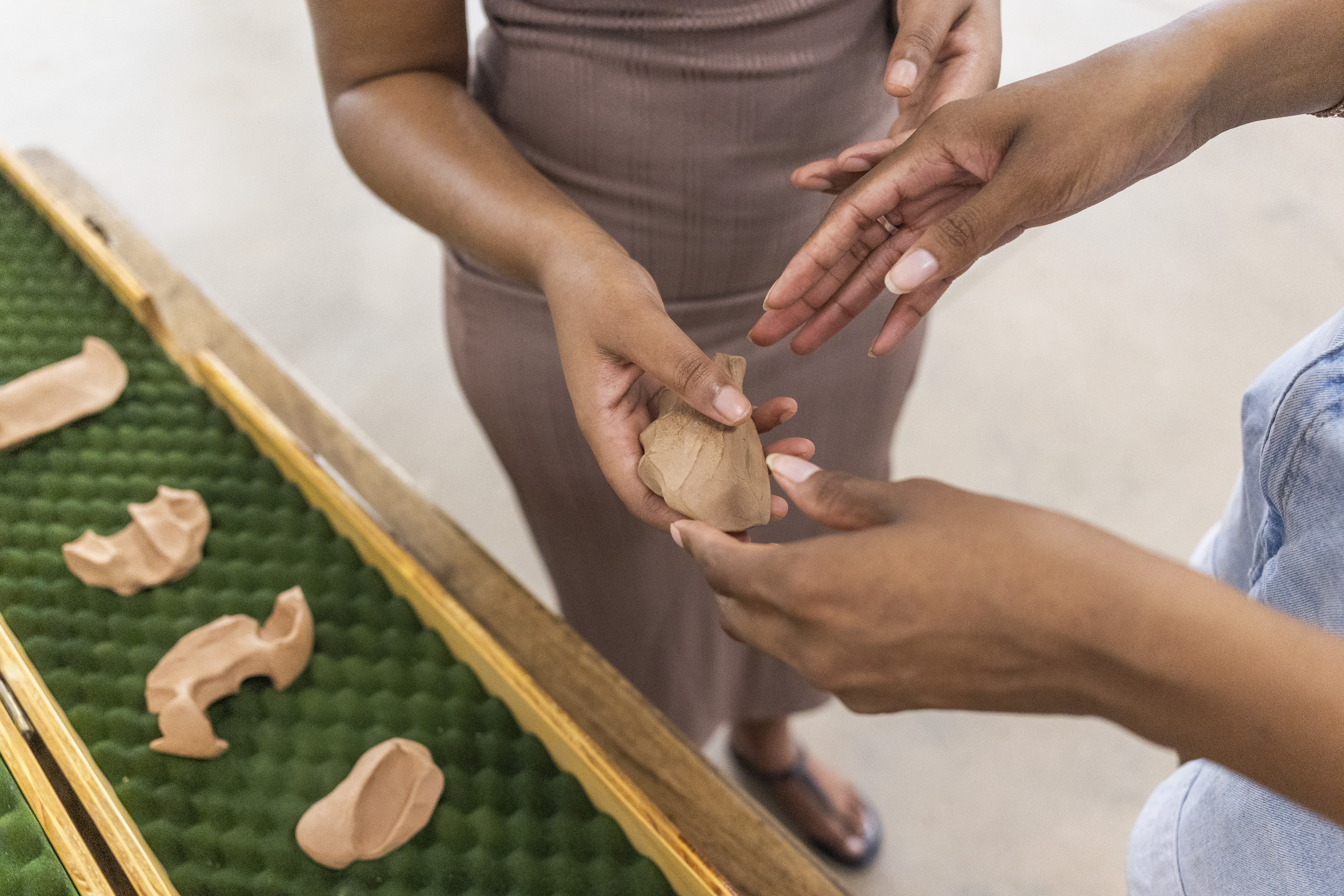
This artwork has been specifically made to be touched by members of the public. Please find below some suggested guidelines on how to interact with the work and relevant details about the project.
1. Suggested Guidelines for Interaction the Grasp Sculpture Kit
The artwork is best explored together by people who are visually impaired and sighted.
If everyone in the group is sighted, ask at least one person to close their eyes. You may of course also explore the artwork alone.
As you explore this artwork, please pay attention to what you are feeling. Carefully consider the different textures, temperatures and weight of each part of the artwork.
Begin by placing the palms of your hands face down and next to each other in the centre of the lid of the box. Spread out your hands to the left and the right until you reach the outer edges of the lid (on your way you will find the two clasps to open the box).
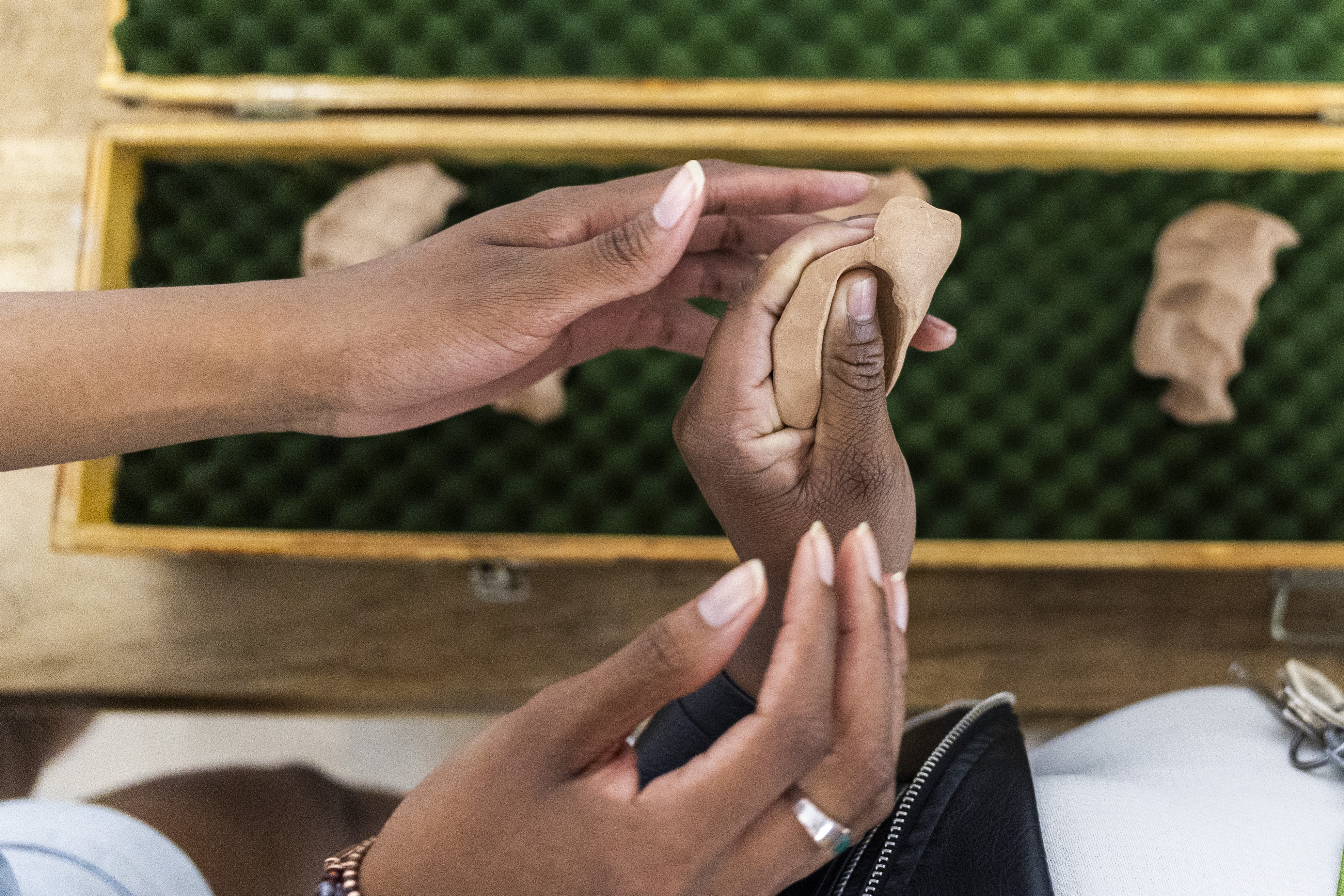
Lift the lid and feel the material underneath it. What kinds of objects might be stored in a box containing this material?
Move your hands closer to your body until they find the forms stored in the box. Use your left hand to pick up the form on your far left. How would you describe the form: is it heavy or light; coarse or fine; flat or rounded; hard or pliable; rough or brittle; clammy or slippery; deep or shallow? Can you fit this form snugly into your hand? Once you have finished exploring this form, place it back into its space on the far left.
Use your right hand to pick up the form on your far right. Explore this form by following the same process as before.
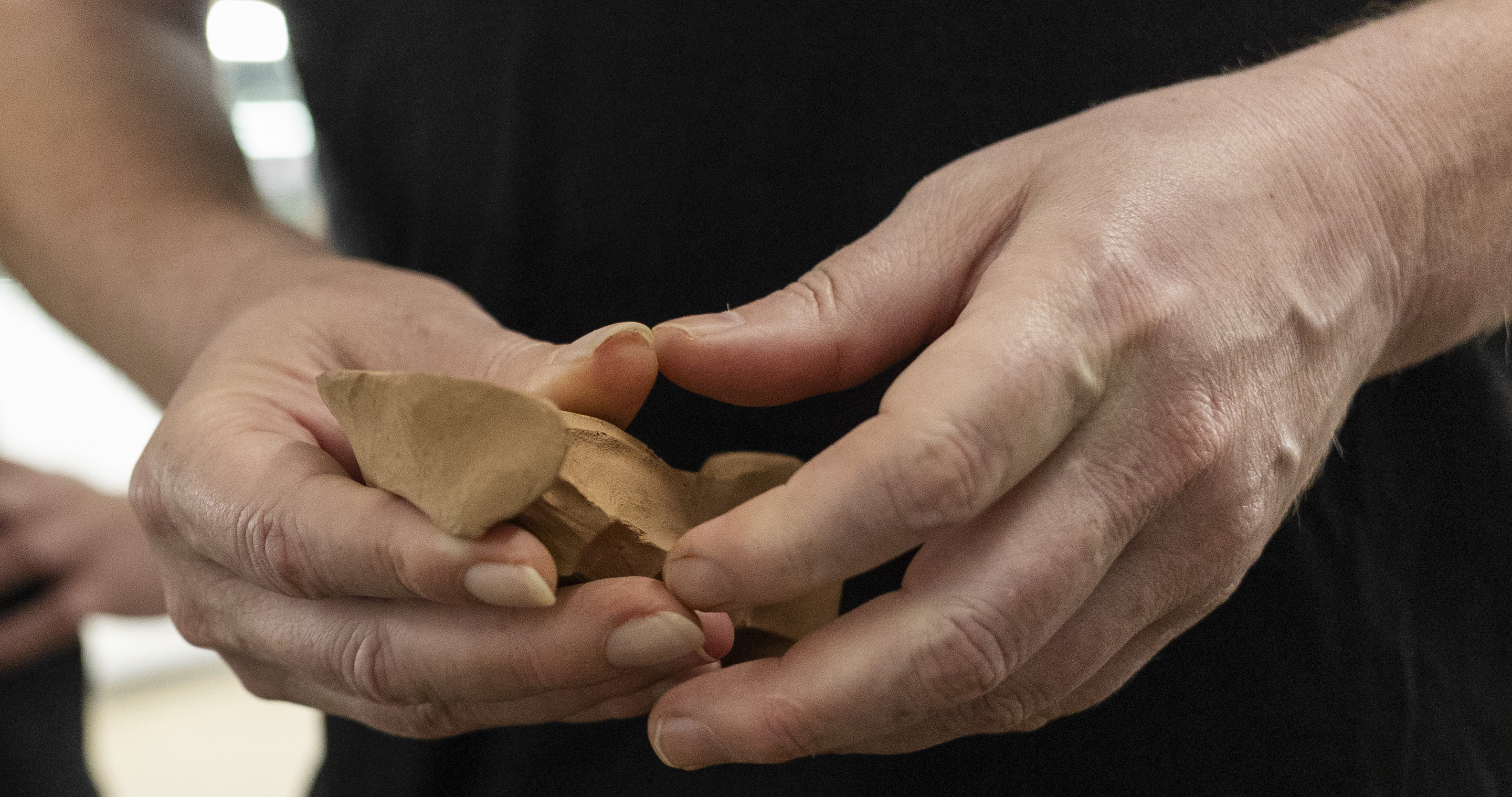
The title of this artwork is Grasp (2024) by Johan Thom and it was produced specifically for exhibition at the Nirox Sculpture Park in the Cradle of Humankind, Kromdraai, South Africa. The artist made each form inside the box by taking a piece of wet clay in his hand and closing his hand around it with varying amounts of pressure. The clay shapes were then dried and baked in a kiln.
When you are holding one of the forms you are actually holding the negative space inside the artist’s hands. The material of soft clay allowed the artist to make the negative space inside his hands visible by giving it solid form. This same process allowed him to produce a world of similar forms that he had never noticed before. (To date the artist has made over a thousand similar clay forms as part of a large-scale art installation by the same name). We might say that Grasp shows the invisible made concrete.
Here are some further prompts for discussion:
- What do you understand about negative space?
- Can you think of other things that we miss or overlook because we cannot see them?
- What is the value of touch in your life?
- How can touching an object be a transformative experience, beyond the commonplace?
- What is the value of hand labour in society today?
- How might the title of the artwork, Grasp, help us to reconsider the various meanings of the relationship between touch and knowledge?
Now explore the other forms and find how they might have fitted into the artist’s hands.
Some of the shapes were made with his left hand, others with his right hand and some with both hands.
What do you realise about the artist as you touch the forms?
Please carefully place all the forms back inside the box and close the lid securely once you are done.
Please also find more information on how to obtain a Grasp Sculpture Kit, a Further Reading List and the Project Credits below.

2. Information on how to obtain an edition of the Grasp Sculpture Kit
The Grasp Sculpture Kit is a tactile artwork primarily meant for teaching, learning and/or simply exploring the value of negative space and touch in sculpture and art.
If you wish to purchase an edition of the Grasp Sculpture Kit for your institution or art collection please contact me at: johan.thom[at]up.ac.za
Where relevant please also clearly state the name of your organisation/ collection, its remit and its function along with your web-address where more information about your institution/ collection may be found for our records.
Please note that the artwork is sold at cost to non-profit institutions such as museums, universities, government schools and other NGOs. Private collectors are also welcome to purchase an edition of the artwork at the unsubsidised price.
2.1 Kit Contents and Technical Details
Medium: Clay (9 unique, handmade clay shapes), pressed wood, foam inner and mixed mediums (hinges, clasps, paint)
Sizes: 195 x 10 x 1190mm
Edition: 50
A signed digital Certificate of Authenticity and copy of the Suggested Guidelines for Interaction are also provided with each edition of the artwork.
3. Some Further Readings on the Tactile in Art and Contemporary Sculpture
- Cranny-Francis, A. 2011. The art of touch: A photo-essay. Social Semiotics 21(4):591-608. http://dx.doi.org/10.1080/10350330.2011.591999
- Driscoll, R. 2020. The sensing body in the visual arts: Making and experiencing sculpture. London: Bloomsbury.
- d’Evie, F., & Kleege, G. 2018. The gravity, the levity: Let us speak of tactile encounters. Disability Studies Quarterly 38(3). https://doi.org/10.18061/dsq.v38i3.6483
- Gallace, A., & Spence, C. 2011. Tactile aesthetics: Towards a definition of its characteristics and neural correlates. Social Semiotics 21(4):569-589. http://dx.doi.org/10.1080/10350330.2011.591998
- Haug, K. 2016. Touching to see: Haptic description and 21st century visuality. LZAQ 1. [O]. Available: https://www.sfaq.us/2016/10/touching-to-see-haptic-description-and-21st-century-visuality/
- Hawkins, H. 2009. Touching art touching you. The Senses and Society (4)3: 379-385. https://doi.org/10.2752/174589209X12464528172175
- Kemske, B. 2009. Embracing sculptural ceramics: A lived experience of touch in art. The Senses and Society (4)3:323-345. https://doi.org/10.2752/174589209X12464528171932
- Lauwrens, J. 2022. Haptic encounters with Willem Boshoff’s Blind Alphabet. Image & Text 36:1-23. http://dx.doi.org/10.17159/2617-3255/2022/n36a26
- Lauwrens, J. 2024. What blind people can teach sighted viewers about art. The Senses and Society 19(2):189-204. https://doi.org/10.1080/17458927.2023.2267410

4. Project Credits
The development of the Grasp Sculpture Kit was kindly funded by a grant from the The Claire and Edoardo Villa Will Trust and produced collaboratively by:
Johan Thom (artist and Associate Professor in Fine Art, School of the Arts, University of Pretoria)
Professor Jenni Lauwrens (Associate Professor in Visual Studies, School of the Arts, University of Pretoria)
The Villa-Legodi Centre for Sculpture at the Nirox Sculpture Park,
Published on the occasion of Grasp, a solo exhibition by Johan Thom curated by Sven Christian and held at the Nirox Sculpture Park in South Africa from 8 September – 20 October 2024 and ‘Touching art, touching lives: Forging bridges through art’, a project with the visually impaired developed and led by Professor Jenni Lauwrens as part of the community engagement module SOA210 at the University of Pretoria and exhibited at the Student Gallery, Javett-UP during the month of September 2024.
Artwork concept and production: Johan Thom
Text: Johan Thom and Jenni Lauwrens
All photographs courtesy of Alet Pretorius
Grasp Sculpture Kit Production: Lourens Pretorius
Edition: 50
All Rights Reserved 2024
For more information please visit:
- http://www.johanthom.com
- https://edoardovilla.co.za
- https://www.villa-legodi.com/
- https://www.niroxarts.com/
- https://www.up.ac.za/
- https://casawabi.org/en/
5. Special Thanks
Grasp was made in South Africa directly following time Johan Thom spent as a resident artist at Casa Wabi in Mexico in April-May of 2024 – a space globally renowned for its extensive involvement with clay as artistic medium and its radical architectural design. Here Thom first deeply engaged with the possibilities of clay as primary medium especially in relation to the human body, its labour and relationship to the greater environment. Thank you to everyone at Casa Wabi.
The National Research Foundation, The Nirox Sculpture Park, The Clair and Edoardo Villa Trust and the School of the Arts, University of Pretoria for providing funding and logistic support for the residency at Casa Wabi.
Sven Christian and Zanele Mashinini for their professional, friendly assistance with the kiln at the VIlla-Legodi Centre for Sculpture at the Nirox Sculpture Park.
Lourens Pretorius for his considered, patient assistance with the production of the wooden case for the kit.
 johanthom.com