

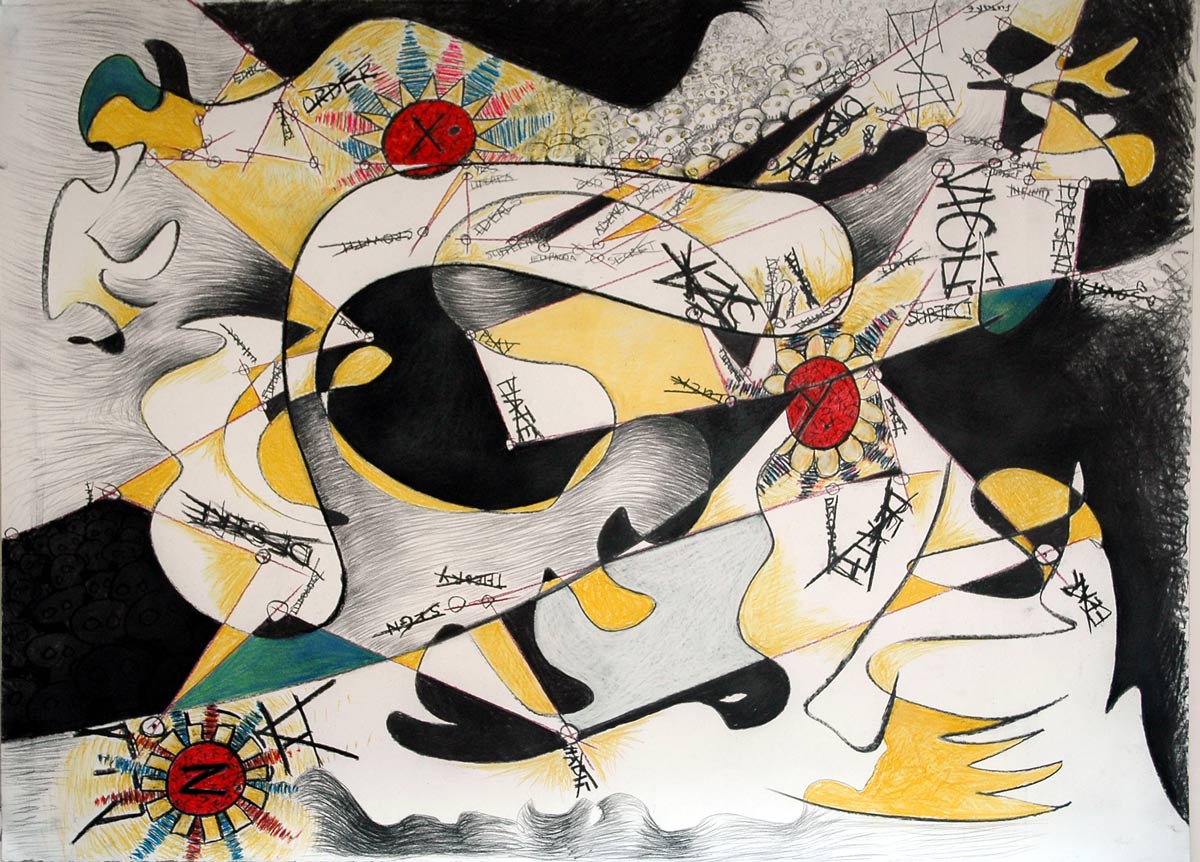

From 2005 onward Thom has actively created visual diaries that document his changing experiences, thoughts and conceptual interests. These works are intended to function as personal maps that detail exact experiences of a particular time and place within a codified, abstract form of ‘personal writing’. In essence the drawn diaries function as a mixture between documentation, research and conceptual experimentation. Each page may be viewed as a meditation on form of sorts. Over time the drawings have become more abstract and gestural.
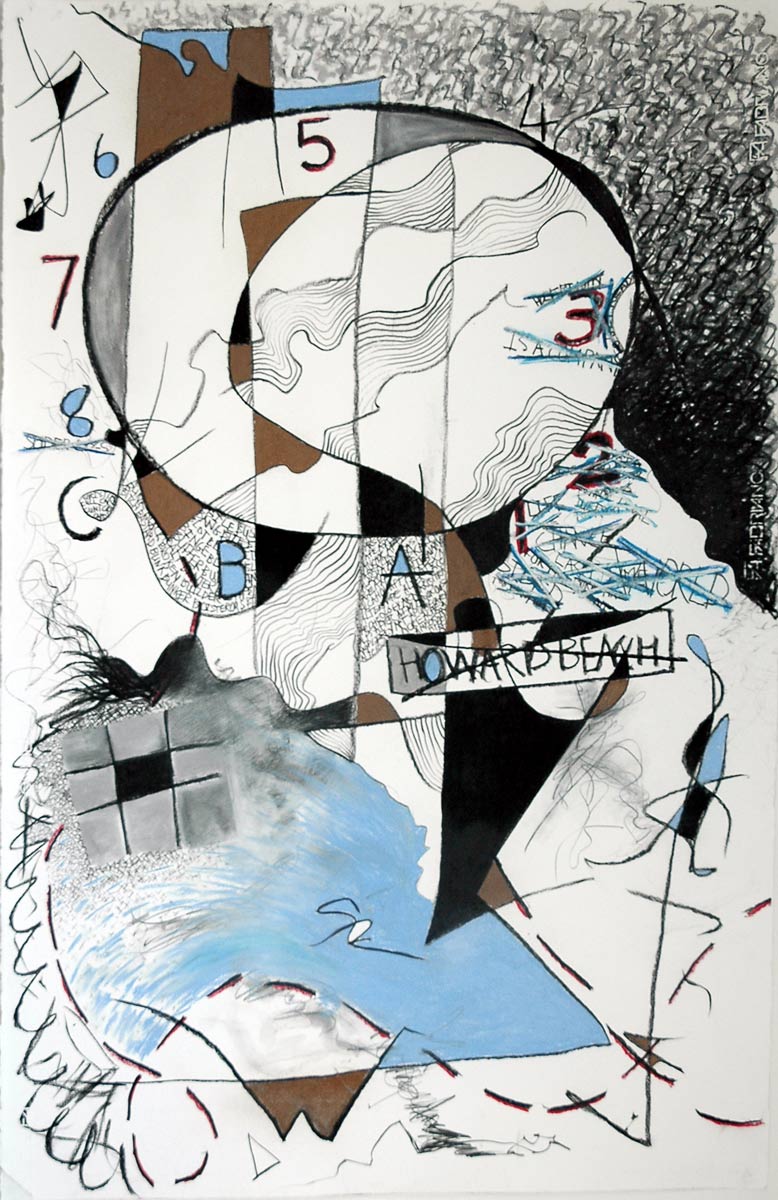
Below and above is a selection of pages from individual diaries including The Diary of New York (2005), Bangladesh (2006), Belgrade (2006), Johannesburg (2007). The pages of the diaries vary in scale, from small 30 x 30 cm to as large as 150 x 125cm. The diaries do not follow any particular formal structure and could be viewed as ‘drawings’ or even as pre-sketches in a more traditional sense: often these cartographies foreground or expand upon other performances/ video and installation works in terms of conceptual motif.
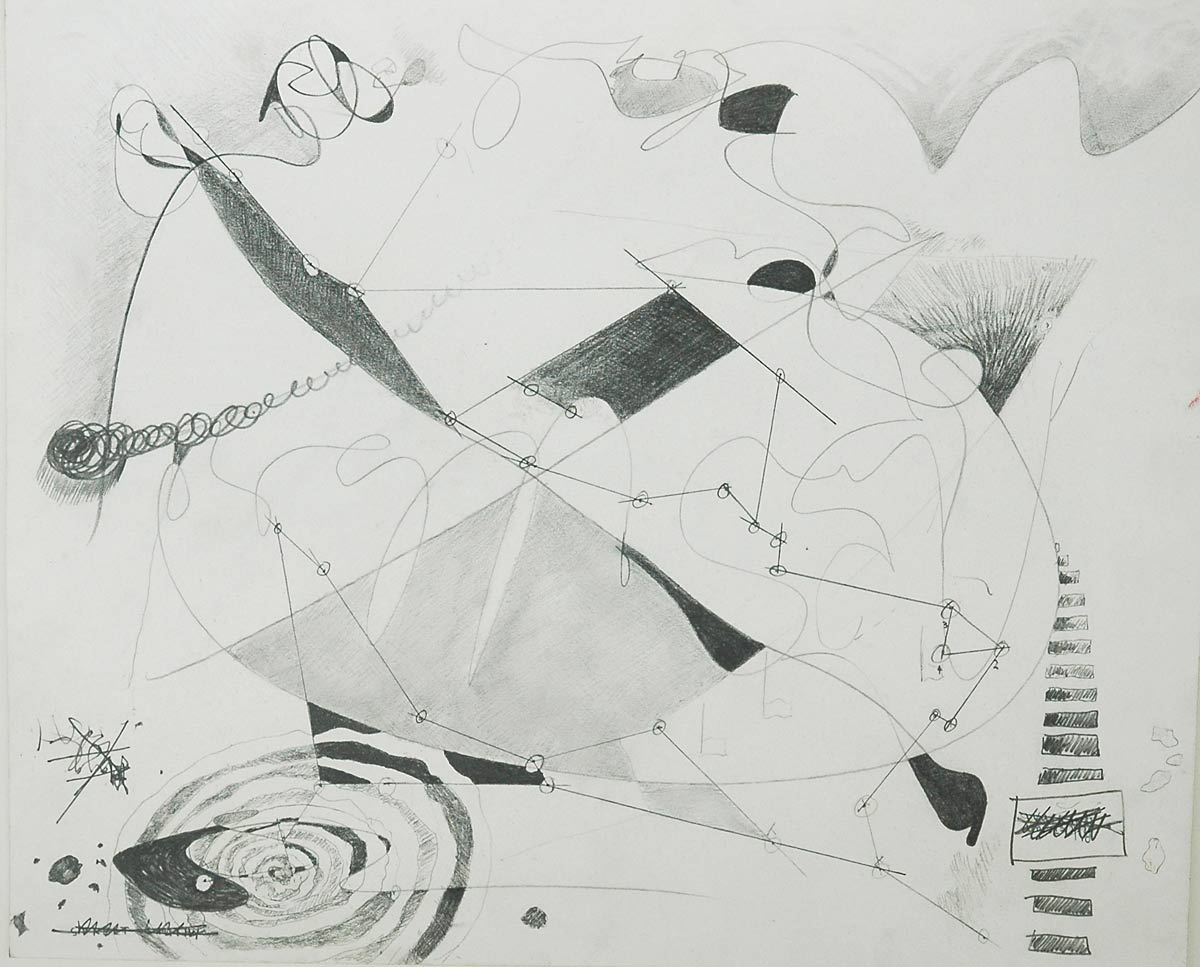
The works are intended to be viewed as maps that trace the body’s movement through space and time (i.e. as it moves through a particular milieu; as it creates marks on the surface of the paper; or as it in turn forms a surface for inscription of the social). Formally the diaries are characterized by the usage of language, abstract forms and gestural marks, pictographic elements, cosmological/ mathematical measurements, dates and figures from philosophy/ literature/ art/ religion. Thom’s trademark dark sense of humor abounds throughout these bodily ‘writings’. Owing to the fact that they are process based works, the diaries are not always meant to form a coherent body of work.

In the later drawings such as the clay based drawings (2024 onward) the bodily, gestural nature of mark-making have become more prominent, leaving less room for graphic and pictorial elements and becoming more layered, material engagements. The use of blakcboard paint first tested roundabout 2007 in the Diary of Johannesburg shown above became a staple element establishing a methodology of layering, erasing and re-inscribing that woudl become the hallmark of all the subsequent drawings.
Excerpt from and interview with Laurie Farrel (NY) for The Diary of New York (2005)
– a solo exhibition at the Graskop Art Gallery, South Africa (2006) organized by Harrie Siertsema and Abrie Fourie of MAP SOUTH AFRICA
Johan Thom is an artist whose work continually pushes conceptual boundaries. Thom stages unsettling performances which physically challenge his body and the comfort zones of his audience. Whether he is inserting foreign objects into his skin or creating paintings on a wall with his own blood, his work brings together theories and energy into dynamic, almost shamanistic performances.
In summer 2005 Thom came to New York City through the Ampersand residency program. During this period Thom created a substantial body of works on paper. He set aside time each day to observe everyday life (often from the rooftop of the Ampersand apartment in Tribeca). He then translated his findings into a series of energetic cartographies which map confrontations between observations made in the real and those made in another world. This other world takes us on a voyage out of passive complacency into a dynamic exercise of interpreting Thom’s complex system of symbols, game boards and elaborately conceived environments. The following conversation is the product of a series of email exchanges that investigate a path into the works on paper of Johan Thom.
LAF: This body of drawings represents a significant departure from your work in performance. What prompted you to create this series?
JT: Long before my departure for New York I felt that I wanted to write my own manifesto, so to speak. So, for me there are two basic levels of experience at stake in writing this Diary: One, that of the reality of my experiences in NY – my body and mind in that space for that time; Two, my thoughts and experiences as an artist who had been forging an aesthetic and a modus operandi over the course of a decade and now felt ready to ‘write’ it down. In this way, writing the Diary was a cathartic experience for me.
I was a drawing artist long before performance became my primary field of artistic expression. When I was an undergraduate art student I admired the work of Diane Victor and William Kentridge immensely. I just felt like they had done everything I wanted to do with drawing already. Thus, in an attempt to (re) shape my own identity as an artist I abandoned this medium and decided to only return to it once my own concepts were more mature. This process took nine years in total (during which time I researched sculpture, abstract expressionism, conceptualism and performance art, amongst other things). Today I consider myself a conceptual artist and will use any medium for its strategic or logistic value to clearly communicate my concepts (even if other artists have successfully explored the same medium countless times before).
That said, many of my performances bear witness to an ongoing fascination with the relationship between the act of mark-making and the concept of catharsis. So in hindsight, I never really stopped drawing.
LAF: You dedicated a great deal of time to studying people and places in New York. Can you explain some of the concepts behind this body of work? How does it relate to your Village Idiot*(see footnote below) series?
JT: I wanted to capture all my experiences of, and in, New York without becoming embedded in the struggle to be objective about it. That’s why a free flow of ideas, words and images, sometimes taken from the street, the subway or even a book that I was reading at the time (such as ‘The Plague’ by Albert Camus) pops up everywhere. Everyday I would wake up at six and go up to the roof of the Ampersand flat to write a new diary entry. Some mornings I just watched New York wake up – joggers, cyclists, parents with their children and lonely stragglers on their way to work, all going through their familiar morning rituals. Other days I would deliberately get ‘lost’ on the subway for hours on end, experiencing and observing the ebb and flow of the trains` bumpy journey through New York. All the time I would have my sketchbook with me, mapping each experience in a kind of shorthand vocabulary of symbols and signs that I could later re-think and rework as a new Diary entry, one that made no distinction between the objective facts of my journey and my subjective responses thereto…
*Footnote: This series later became the ‘Perfect Human Series’ including works such as The Theory of Evolution (2006), The Theory of Gravity (2006), The Theory of Flight (2006) amongst others.

 johanthom.com