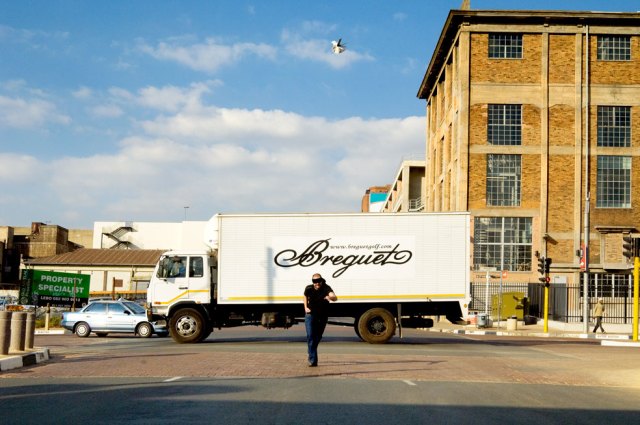
Photographic still from ‘Vox Populis Vox Dei’
PRESS RELEASE: ‘DYSTOPIA’
Dates & venues:
May 23 – June 30, 2009: Unisa Art Gallery, Pretoria
October 8 – November 15, 2009: Museum Africa, Johannesburg
June 10 – August 8, 2010: Oliewenhuis Art Museum, Mangaung
October 17 – November 21, 2010: Jan Colle Galerij, Ghent
Curator: Elfriede Dreyer
Associate professor, Department of Visual Arts
University of Pretoria
Contact: +27 832712342 (mobile)
elfriede.dreyer@up.ac.za
Assistant curator: Jacob Lebeko
Assistant-curator, Unisa art gallery
University of South Africa
Contact: +27 12 4296255
lebekj@unisa.ac.za
Participating artists: Adelle van Zyl; Brett Murray; Celia de Villiers; Christiaan Diedericks; Christiaan Hattingh; Churchill Madikida; Collen Maswanganyi; Dale Yudelman; Daniel Halter; Diane Victor; Dineo Bopape; Elfriede Dreyer; Frikkie Eksteen; Guy du Toit & Iaan Bekker; Gwenneth Miller; Jenna Burchell; Jan van der Merwe; Johan Thom; Kai Lossgott; Karlien de Villiers; Kudzanai Chiurai; Lawrence Lemaoana; Minnette Vári; Moshekwa Langa; Nicholas Hlobo; Pieter Swanepoel; Steven Cohen; Thando Mama; William Kentridge, Claire Gavronsky & Rose Shakinovsky; Zanele Muholi
Art often serves an observational, analytical and interpretational purpose. Both art’s mimetic function and its imaginative aspect provide powerful means by which any society can introspect, investigate and visualise itself as a capsule of the socio-cultural and political status quo.
Within the geographical boundaries of Southern Africa, Dystopia explores the relationship of contemporary art production to society and ideology, and aims to unmask articulations of dystopia within this cultural framework. A main curatorial intention with the exhibition is to express the view that the dystopian artworks included in this exhibition and the cultural criticism articulated therein seem to have responded to an air of crisis that has been pervading contemporary thinking for several decades now.
In principle, dystopian texts express world views that postulate end-of-utopia, utopia-gone-wrong and even anti-utopia, and entail responses to and a critique of utopia. In the dystopian genre the imagination is tweaked as a critical instrument set on deconstructing existing or potential ills, injustices and hypocrisies in society, mainly brought on by utopian ideologies and legacies. In dystopian texts — whether real or fictive; visual or literary — stories are told about, for instance, societies and places where the impact of the ideological blueprint of globalisation has created diasporic cultures and nomad identities; about unjust utopian political ideas that create social restriction, impaired mobility, repression or oppression; or about postutopian space and loss of religious belief and direction. It might recount posthuman conditions as a result of the dominating influence of the technological utopianism, evident in dysfunctional cyberrelationships and telematic influences leading to rampant violence, threat to self, insensitivity and indifference to critical socio-cultural problems.
Broadly speaking, Dystopia deals with the following themes: political utopia-gone-wrong; teleology and apocalypse; dystopian contestations of gender, race and culture; spatiality and boundaries as postideological zones; the postindustrial city; and technodystopia. The artworks that have been selected for the exhibition function as palimpsests where dystopian maps have been superimposed over utopia, but also as utopian constructions where dystopian realities have been absorbed, negated and transcended in order to generate a new utopian synthesis.
A significant metatext in the conceptual architecture of the exhibition is the role and use of various kinds of technologies from low-tech to high-tech digital tools in the production of the artworks. The objective here is to come closer to an understanding of the way in which culture produces itself and attributes meaning to that self-production. The appropriated technologies reflect social processes, histories and conditions in South Africa and as such provide a kind of technological “barometer” for, for instance, rural village settings, inner city diasporic communities and consumer environments.
The exhibition consists of a combination of recently and newly produced work of South African artists, both emerging and internationally acclaimed, as well as selected artworks from the University of South Africa’s art collection.
A comprehensive catalogue and an educational programme accompany the exhibition. There will be walkabouts on Friday, May 29, and Friday, June 19, at 13h00. A panel discussion will take place in the Unisa Art Gallery on Saturday, May 30, from 10h00 to 13h00.
Dystopia is primarily funded by the National Research Foundation of South Africa under the Key International Science Capacity (KISC) Initiative, as well as by Unisa.
Read Full Post »
 johanthom.com